

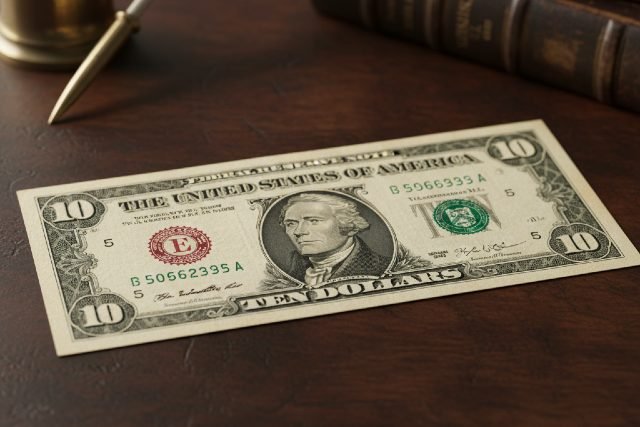

If you’ve found a 1934 ten dollar bill in a collection, old wallet, or estate, you might be wondering: Is it rare? What’s special about it? The 1934 series $10 is a fascinating piece of U.S. currency history, tied to the Great Depression, gold recall, and major design and policy changes in American money.
In this guide, we’ll break down the history, design features, series varieties, and signatures found on the 1934 ten dollar bill, plus give you tips on what collectors look for and how to tell if yours might be worth more than face value.
Overview: Why the 1934 Ten Dollar Bill Matters
The 1934 ten dollar bill stands out because it:
- Appears in multiple series: 1934, 1934A, 1934B, 1934C, and 1934D
- Exists mainly as Federal Reserve Notes, but you’ll also see 1934 ten dollar gold certificates and other types tied to this year
- Reflects the post–gold standard era after the 1933 gold recall
- Features older-style, large “white space” designs that differ from our modern, colorful notes
For collectors, the 1934 $10 is extremely common in circulated condition, but certain star notes, low serial numbers, and nice uncirculated examples can be quite desirable.
Basic Facts About the 1934 Ten Dollar Bill
Here’s a quick snapshot:
| Feature | Details |
|---|---|
| Denomination | Ten dollars ($10) |
| Series | 1934, 1934A, 1934B, 1934C, 1934D |
| Type (most common) | Federal Reserve Note |
| Portrait | Alexander Hamilton |
| Back Design | U.S. Treasury Building |
| Size | Small-size note (modern size) |
| Color | Green seal & serials (FRNs) |
(Note: There are also 1934 $10 gold certificates with an orange/gold back, but those are a separate type from standard Federal Reserve Notes.)
Historical Context of the 1934 Ten Dollar Bill
The Series of 1934 came directly on the heels of:
- The Great Depression
- President Franklin D. Roosevelt’s 1933 gold recall
- The U.S. leaving the traditional gold standard for circulating paper money
Earlier notes said they were “payable in gold” or “in gold coin.” By 1934, wording began to change to reflect the reality that citizens could no longer redeem paper currency for gold. The 1934 series is part of that transition era where the government re-framed what paper money represented: legal tender backed by the full faith and credit of the United States, not directly redeemable gold.
Design Details of the 1934 Ten Dollar Bill
Obverse (Front) Design
On the front of a typical 1934 ten dollar bill (Federal Reserve Note), you’ll see:
- Portrait: Alexander Hamilton, first Secretary of the Treasury, centered slightly to the left
- Denomination: Large “TEN” and “10” in each corner
- Seal: Green Treasury seal (for FRNs) on the right side
- Serial numbers: Two green serial numbers, one on each side
- Wording:
- “FEDERAL RESERVE NOTE” at the top
- “THE UNITED STATES OF AMERICA”
- “WILL PAY TO THE BEARER ON DEMAND TEN DOLLARS” (older obligation wording)
Reverse (Back) Design
On the back:
- Central image of the U.S. Treasury Building in Washington, D.C.
- “THE UNITED STATES OF AMERICA” and “TEN DOLLARS” around the design
- Decorative scrollwork and classic engraving style
Even though it’s older, the 1934 $10 still counts as legal tender today and can be spent at face value—though it’s often worth more to collectors.
Types of 1934 Ten Dollar Bills You Might See
When people say “1934 ten dollar bill,” they might be referring to one of several types:
- 1934 $10 Federal Reserve Note (Green Seal) – most common
- 1934A–1934D $10 Federal Reserve Notes – later series revisions
- 1934 $10 Gold Certificate (Gold Seal, Yellow/Orange Back) – collectible type, no longer redeemable in gold
- Less common specialized issues (like certain emergency or experimental notes in other denominations around that era, though not usually for the $10)
In most casual finds, you’re looking at a green-seal Federal Reserve Note.
Understanding “Series” on the 1934 Ten Dollar Bill
The word “Series of 1934” printed on the bill doesn’t mean the note was printed only in 1934. It refers to:
- The basic design and legal wording authorized at that time
- A design family that could be printed over many years
When small changes happened — usually new officials’ signatures — the letter after the date changed:
- Series 1934
- Series 1934A
- Series 1934B
- Series 1934C
- Series 1934D
These changes mainly reflect updates in:
- Treasurer of the United States signature
- Secretary of the Treasury signature
Signatures on the 1934 Ten Dollar Bill
Each 1934 ten dollar bill carries two printed signatures:
- Treasurer of the United States
- Secretary of the Treasury
Depending on the exact series and print run, you will see pairs such as:
- Julian – Morgenthau (very common combination on 1934-era notes)
- Later series have different Treasurer/Secretary combos as officials changed
Collectors sometimes use these names to quickly identify the print period or series variety.
Why Signatures Matter
- Help identify which series of 1934 you have
- Can affect value in combination with other features like Federal Reserve district and star notes
- Some signature combinations on certain denominations/series can be slightly scarcer
Federal Reserve Districts on 1934 $10 Bills
1934 ten dollar Federal Reserve Notes were issued for different Federal Reserve districts, each with:
- A letter (A–L)
- A corresponding city name like Boston, New York, Atlanta, San Francisco, etc.
- Matching letter in the seal and district number
Example:
- “B” – New York
- “L” – San Francisco
Certain district/series combinations can be more collectible if they had lower print runs or are scarcer in high grade.
Star Notes: Special 1934 Ten Dollar Bill Replacements
One of the most important things collectors look for is whether a note is a star note.
How to Spot a Star Note
- Look at the serial number
- If there is a ★ (star) symbol before or after the digits instead of a normal letter, it’s a replacement note
Star notes were printed to replace misprinted or damaged notes and tend to have smaller print runs, making them more collectible — especially in high grade.
Condition (Grade) and Value Basics
While this article is focused on history and design, most readers also want a quick sense of value ranges. Very generally:
- Heavily circulated 1934 $10 FRNs: often worth $10–$15
- Lightly circulated: maybe $15–$25 depending on eye appeal
- Crisp Uncirculated (CU): can be $40–$100+, more for scarcer district/series
- Star notes, rare districts, or high grades: significantly more
A 1934 ten dollar bill gold certificate (gold seal) or a rare variety can be worth much more, especially in nice condition.
For serious pricing and population data, collectors rely on professional grading services and price guides rather than casual estimates.
How to Read Your 1934 Ten Dollar Bill (Step-by-Step)
Use this checklist to decode your note:
- Check the front for “Series of 1934,” “1934A,” etc.
- Find the Federal Reserve district letter and city (e.g., “D – Cleveland”).
- Look at the serial number – any star? any repeating or low number?
- Identify the signatures – which Treasurer and Secretary names?
- Examine the seal color – green (FRN) vs gold (gold certificate).
- Evaluate condition – tears, folds, stains, writing, crispness.
These details help you understand both history and potential collector interest.
Common Questions About the 1934 Ten Dollar Bill
1. Is a 1934 ten dollar bill rare?
Most 1934 $10 Federal Reserve Notes are not rare in circulated condition. However, certain combinations (district + series + star note + high grade) can be much scarcer and more valuable.
2. Can I spend my 1934 $10 at face value?
Yes. It’s still legal tender and can be used just like a modern ten-dollar bill — but collectors will usually pay more than face value if it’s in good shape.
3. What’s the difference between a 1934 $10 FRN and a 1934 $10 gold certificate?
- FRN (green seal) – backed by the general credit of the U.S., still widely used type
- Gold certificate (gold/orange features) – once redeemable in gold, now just collectible paper money with no gold redemption, often more valuable to collectors
4. Does the series letter (A, B, C, D) change the value?
Sometimes. By itself, the series letter doesn’t guarantee high value, but certain scarcer series/district combinations can be more desirable — especially as uncirculated or star notes.
5. Where can I get an accurate appraisal?
For higher-value notes, consider:
- Local coin & currency dealers
- Reputable auction houses
- Professional grading services (PCGS Banknote, PMG)
These can give more precise valuations based on grade, rarity, and market demand.
Collecting Tips for the 1934 Ten Dollar Bill
If you’re interested in collecting:
Focus Areas to Consider
- High-grade (Crisp Uncirculated) examples
- Star notes
- Complete district sets (all 12 Federal Reserve Banks)
- Series progression (1934 through 1934D)
- Specialty themes like:
- Low serial numbers
- Radar or repeater serial numbers (e.g., 1221 1221)
Storage and Preservation
To protect your 1934 ten dollar bills:
- Store in acid-free currency sleeves
- Keep away from heat, moisture, and direct sunlight
- Avoid folding or handling with bare, oily hands
Proper storage preserves both value and appearance.
Quick Identification Table: 1934 Ten Dollar Bill at a Glance
| Feature | What to Look For |
|---|---|
| Year/Series | “Series of 1934,” 1934A, 1934B, 1934C, 1934D |
| Type | Federal Reserve Note (green seal) or gold cert |
| Portrait | Alexander Hamilton |
| Back Design | U.S. Treasury Building |
| Seal Color | Green (FRN) / Gold (gold certificate) |
| District | Letter & city (A–L) |
| Star Note | Star symbol in serial number |
| Condition | From heavily worn to crisp uncirculated |
Why the 1934 Ten Dollar Bill Is a Great “Starter” Collectible
Compared to some older notes, the 1934 ten dollar bill is:
- Accessible (many survive in decent condition)
- Historically interesting (Great Depression and gold standard changes)
- Visually classic with Hamilton and the Treasury Building
- Affordable in lower grades yet still collectible
If you’re just getting into paper money collecting, it’s an excellent early note to learn from and build around.
Conclusion
The 1934 ten dollar bill is more than just old money — it’s a snapshot of a turning point in U.S. financial history. With its classic Alexander Hamilton portrait, Treasury Building reverse, multiple series (1934 through 1934D), and signature changes, it offers collectors and history buffs plenty to explore.
By understanding its history, design, series variations, and signature combinations, you can better appreciate what you have and decide whether it’s simply a cool keepsake or a note worth grading and preserving. Next time you come across a 1934 $10, you’ll know exactly how to read it, what to look for, and why it still matters today.











Leave a comment