

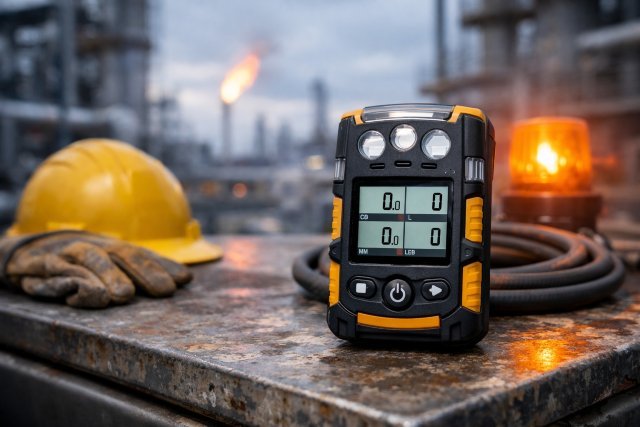

If you work around confined spaces, tanks, manholes, sewers, drilling sites, or industrial plants, a 4 gas monitor is one of the most practical safety investments you can make. It’s designed to continuously sample the air you’re breathing and warn you early — before a hazardous atmosphere becomes a medical emergency or an ignition risk.
In many real incidents, the first person goes down and coworkers rush in to help, only to become victims themselves. NIOSH has warned that more than 60% of confined-space fatalities occur among would-be rescuers, which is exactly why reliable atmospheric testing and continuous monitoring matter.
What a 4 gas monitor detects, which features actually matter, how to compare models intelligently, and how to avoid the most common buying mistakes — so you can choose a device that fits your work, not just your budget.
What is a 4 gas monitor?
A 4 gas monitor (also called a 4-gas detector or multi-gas monitor) is a portable instrument that typically measures four core atmospheric hazards:
- Oxygen (O₂) to detect oxygen deficiency or enrichment
- Combustible gases (LEL) to detect explosion/ignition risk
- Hydrogen sulfide (H₂S) as a common high-toxicity gas
- Carbon monoxide (CO) as a common toxic gas from engines, fires, and incomplete combustion
Why these four? Because they map closely to the most frequent “silent killers” and fire/explosion triggers in industrial environments and confined spaces.
OSHA guidance and standards commonly reference oxygen thresholds such as maintaining oxygen content at or above 19.5% (and often not exceeding an upper threshold such as 22% in certain contexts). And for CO, OSHA’s permissible exposure limit (PEL) is 50 ppm as an 8-hour TWA, which strongly influences alarm strategies and program limits.
Why a 4 gas monitor matters in real-world work
A “bad air” incident isn’t always dramatic. Often it starts with subtle symptoms — lightheadedness, headache, confusion — right when you need sharp judgment. CO and H₂S are especially dangerous because exposure can escalate quickly, and in some cases you can’t rely on your senses.
For example, the NIOSH Pocket Guide notes that H₂S can fatigue your sense of smell, meaning the “rotten egg” warning odor may disappear even while the hazard remains.
The impact is not hypothetical. A Bureau of Labor Statistics fact sheet reported that from 2011 to 2018, 1,030 workers died from occupational injuries involving a confined space, with annual totals ranging widely year to year. This is exactly the environment where a properly selected and properly maintained 4 gas monitor earns its keep.
How a 4 gas monitor works
Most portable 4-gas units combine several sensor types:
Oxygen sensor (electrochemical)
Measures oxygen concentration as a percentage. It’s essential because many deadly atmospheres are not “toxic” in the traditional sense — they’re simply low-oxygen. OSHA references oxygen-deficient atmospheres and emphasizes maintaining oxygen content at 19.5% or higher in relevant standards.
Toxic gas sensors (electrochemical for CO and H₂S)
These measure gas in parts per million (ppm). They’re built for sensitivity at relatively low concentrations because toxic effects start well below “visible” danger.
- CO exposure guidance commonly references OSHA’s 50 ppm PEL (8-hour TWA).
- For H₂S, NIOSH lists an IDLH of 100 ppm, highlighting how quickly it can become life-threatening.
Combustible gas sensor (catalytic bead or infrared)
This reports gas concentration as a percentage of the Lower Explosive Limit (LEL). Many confined-space programs target keeping flammables below 10% LEL prior to entry; industry guidance frequently references this threshold when discussing confined-space measurement practices.
4 gas monitor vs. “single-gas” detectors: when each makes sense
A single-gas detector can be fine when the hazard is known, stable, and you have strong controls (for instance, a dedicated CO monitor in a facility where CO is the primary variable). But confined spaces and many industrial work zones rarely offer that certainty. Atmospheres can stratify, shift with ventilation changes, and vary by task (cleaning solvents, purging, hot work, engine exhaust, biological decomposition, and so on).
If your job includes any kind of unknown-atmosphere entry or work where conditions can change fast, a 4 gas monitor is usually the safer baseline because it covers the major categories: oxygen displacement, toxic exposure, and combustion risk.
4 Gas Monitor buying criteria that actually affect safety
1) Sensor configuration and what “LEL” really covers
The “standard four” (O₂, LEL, H₂S, CO) covers a lot, but not everything. If your environment involves CO₂ buildup, ammonia, chlorine, SO₂, VOCs, or refrigerants, you may need a different sensor package or a separate instrument.
Tip: treat LEL as “flammables risk” rather than “it detects every flammable perfectly.” Catalytic bead sensors can be poisoned by some compounds and require oxygen to function properly. Infrared LEL sensors can perform better in some harsh conditions, but may not detect hydrogen the same way depending on design. If your work includes inerting/purging with nitrogen, that’s a strong signal to talk to your safety lead about sensor limitations — because oxygen deficiency can make some LEL readings misleading.
2) Alarm behavior you can trust (audible, visual, vibration)
The best gas monitor is the one you can’t ignore. In the real world, alarms need to cut through:
- engine noise
- hearing protection
- poor visibility
- cramped spaces and awkward body positions
Look for strong multi-modal alarms (loud audible + bright visual + aggressive vibration). Also look for clear on-screen messaging: “HIGH CO,” “LOW O2,” etc., not just tiny numbers.
3) Data logging and incident proof
Data logs are not just for compliance paperwork. They help you answer questions like:
- Did the atmosphere change after ventilation stopped?
- Did the entrant’s monitor alarm before symptoms began?
- Were readings stable at the top of the space but hazardous near the bottom?
If you do permit-required confined space entry, logging is often valuable for documenting safe entry conditions and post-job review.
4) Durability and ingress protection for your environment
If you work around water spray, dust, mud, or corrosive environments, durability is not a “nice to have.” It’s a reliability requirement. Look for strong drop ratings, water/dust protection, and a proven record in your industry (wastewater, oil & gas, utilities, industrial maintenance, shipyards, etc.).
5) Calibration, bump testing, and the true cost of ownership
The price tag on the monitor is only part of the cost. Your real cost includes:
- calibration gas and regulators
- docking station (optional but time-saving)
- sensor replacement cycles
- downtime and administrative workflow
Some manufacturer documentation notes that alarm thresholds can vary by regulation and policy and advises checking the monitor/certificate for exact setpoints. That’s a reminder that your program needs a calibration and verification routine that matches your procedures, not just the default factory settings.
Quick comparison checklist (use this when shopping)
You can copy/paste this into your notes while comparing product pages:
- Does it measure O₂, LEL, CO, H₂S (and can it be configured for other gases if needed)?
- Are alarms loud enough for your worksite and does it vibrate strongly?
- Does it log data and is it easy to export reports?
- Battery life: does it reliably last your longest shift with margin?
- Is it easy to bump test and calibrate (manual or docking station)?
- Are replacement sensors readily available where you operate?
- Is it certified for hazardous locations relevant to your region (ATEX/IECEx/UL/CSA as applicable)?
- Can you read it in bright sunlight and low light?
- Does your team actually like wearing it (size/weight/clipping comfort)?
Common mistakes people make when buying a 4 gas monitor
Buying on price alone
Cheaper units can be perfectly fine if they’re certified, supported, and maintained. But the risk is often hidden in support, sensor availability, calibration workflow, and alarm clarity.
Assuming “factory alarms” match your policy
Different companies set different alarm thresholds. Always verify what the unit ships with and whether it’s adjustable to your program needs.
Skipping bump tests because “it calibrated last month”
Calibration proves accuracy at that moment in time. Bump tests are a quick confidence check that sensors and alarms respond at all. Many safety programs treat both as essential parts of readiness.
Using a 4 gas monitor as the only control
A monitor is a warning system, not a substitute for ventilation, lockout/tagout, isolation, and permit-required confined space procedures. NIOSH emphasizes testing and continual monitoring because many fatalities are atmospheric in nature, and rescuer deaths are common when people rush in without proper controls.
FAQ: 4 Gas Monitor questions buyers ask most
What gases does a 4 gas monitor detect?
Most standard units detect oxygen (O₂), combustible gas as %LEL, hydrogen sulfide (H₂S), and carbon monoxide (CO). These four cover the biggest categories: oxygen displacement, explosion risk, and common toxic exposures.
Is a 4 gas monitor required for confined space entry?
Rules depend on your jurisdiction and the type of space, but many confined-space programs require atmospheric testing before entry and continuous monitoring during entry because oxygen deficiency and toxic atmospheres are frequent contributors to fatalities. NIOSH specifically emphasizes testing prior to entry and continual monitoring in its confined-space alert.
What oxygen level is considered unsafe?
OSHA commonly references oxygen deficiency below 19.5% in relevant standards and requires controls to keep oxygen at or above that threshold in certain settings. Always follow your written program and the applicable regulation for your industry.
How often should a 4 gas monitor be calibrated?
Follow the manufacturer instructions and your safety program. In practice, many workplaces bump test before use (or daily) and calibrate on a scheduled interval (often monthly or per policy), plus after any sensor replacement or abnormal exposure event. The goal is to ensure the instrument responds correctly and reads accurately.
Can I rely on smell to detect hydrogen sulfide?
No. The NIOSH Pocket Guide warns that sense of smell can become fatigued and cannot be relied upon to warn of continuous H₂S presence. That’s a core reason H₂S sensors are included in a 4 gas monitor.
What does “IDLH” mean and why does it matter?
IDLH means “Immediately Dangerous to Life or Health.” It’s a NIOSH value intended to represent a concentration that poses an immediate threat to life, causes irreversible effects, or impairs escape. For hydrogen sulfide, NIOSH lists an IDLH of 100 ppm.
Conclusion: choosing the right 4 gas monitor
A 4 gas monitor is not just a purchase — it’s a safety system you carry. The best choice is the one that matches your hazards, is comfortable enough that workers will actually wear it, and is supported by a realistic maintenance routine (bump tests, calibration, sensor replacements, and training).
If you want the simplest rule of thumb: prioritize reliable sensors, unmistakable alarms, and an easy verification workflow. Confined-space incidents frequently involve atmospheric hazards, and rescuer fatalities are tragically common when people enter without proper monitoring and procedures.












Leave a comment