

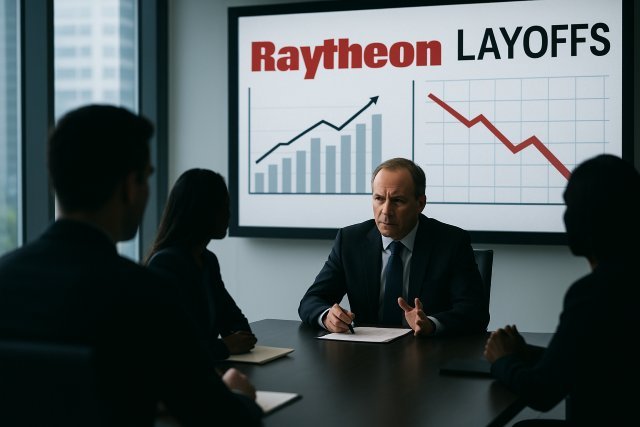

The recent Raytheon layoffs have sent ripples through the aerospace & defense industry, affecting thousands of workers and reshaping organisational strategy. In this article I analyse the reasons behind these job cuts, the economic and regional consequences, and what they suggest about the future of RTX Corporation (formerly Raytheon Technologies Corporation). We’ll also look at what this means for employees, the supply chain, investors and the broader defence market.
What are the Raytheon Layoffs?
Definition: The term “Raytheon layoffs” refers to workforce reductions, plant closures, and restructuring efforts announced by Raytheon/Raytheon-Technologies/RTX across its divisions (e.g., Missiles & Defense, Collins Aerospace) over recent years.
These layoffs arise from contract changes, budget constraints, consolidation of business units, and shifts in strategic focus.
Quick Snapshot
- According to WARN-tracker data, the company has filed numerous layoff notices between 1995 and 2025, affecting thousands of employees.
- Key impacted areas include El Segundo, CA (Raytheon Space Systems) and other US sites.
- These workforce actions coincide with broader industry trends in aerospace & defense.
Why Are the Raytheon Layoffs Happening?
1. Contract and Government Budget Pressure
As a major defence contractor, Raytheon depends heavily on U.S. government budgets, military procurement cycles, and commercial aerospace demand. When budgets tighten or programme priorities shift, jobs are often affected.
For example: Cuts or delays in missile or radar programmes can reduce staffing needs.
2. Strategic Re-Organisation & Efficiency Drive
Raytheon (now RTX) has reorganised business units, merged divisions, and streamlined operations to improve profitability and agility. For instance, reducing redundancies by combining facilities and realigning roles.
Such realignment often leads to overlapping roles and subsequent layoffs.
3. Commercial Aerospace Headwinds
Beyond defence, Raytheon’s aerospace divisions (e.g., Collins Aerospace) are exposed to commercial aviation demand. With aircraft orders fluctuating and supply-chain disruptions persistent, staffing adjustments follow.
Thus, while labelled “defence” layoffs, many are tied to broader aerospace market dynamics.
4. Technological & Market Shifts
Emerging technologies (hypersonics, space, autonomous systems) demand different skill-sets. Legacy operations may decline, prompting workforce adjustment.
In short: Raytheon layoffs signal both cost-cutting and strategic pivoting toward future tech.
Economic & Strategic Effects of the Raytheon Layoffs
Regional & Workforce Impacts
- Local economies where large Raytheon sites are based can feel the impact acutely: lost jobs reduce consumer spending, tax revenues and local contractor business.
- Workers face disruption: severance may help, but job-market uncertainty remains.
- Supply-chain ripple-effects: smaller firms supplying Raytheon’s operations may see decreased orders or contract cancellations.
Company & Industry Strategy
- For Raytheon/RTX, layoffs free up cost-structure for investment in higher-growth areas (space, hypersonics, software).
- The company positions itself leaner and more agile, with fewer “legacy” roles.
- Industry-wide, these layoffs echo broader consolidation: defence prime contractors responding to shifting national priorities and global competition.
Investor & Financial Implications
- Workforce reductions can boost near-term margins (via lower labour cost) but risky if talent-base erodes or morale suffers.
- Investors will watch contract wins/losses, R&D investments, and order backlog to judge long-term health.
- A layoff event may signal caution to some investors, or opportunity to others if seen as strategic rather than purely cost-cutting.
Breakdown: Which Divisions & Roles Are Most Affected?
| Division | Typical Roles Impacted | Notes |
|---|---|---|
| Missiles & Defense | Manufacturing, engineering support, test-operations | Contract shifts and facility consolidation key drivers |
| Collins Aerospace / Commercial | Aerospace systems, supply-chain, support roles | Linked to commercial aviation downturns |
| Intelligence & Space | Program engineering, legacy systems | Emerging tech demands new skills |
These patterns reflect commentary in layoff-tracking sites and news sources.
How Does This Compare with Industry Trends?
The Raytheon layoffs are not isolated. Across the aerospace & defence (A&D) sector:
- Several major primes have announced workforce reductions or re-skills due to geopolitical and budget shifts.
- Commercial aviation suppliers are especially vulnerable to cycle changes and pandemic recovery fluctuations.
- The “dual-use” nature of many systems (military + commercial) means companies need flexible staffing strategies.
In this sense, the Raytheon layoffs reflect both company-specific and industry-wide adjustments.
What This Means for Employees & Communities (H2)
For Employees
- Skill Re-alignment: Those in legacy roles may need to upskill (e.g., software, autonomy, space systems).
- Job Mobility: Employees may move to smaller contractors, non-defence-tech sectors, or rethink career paths.
- Uncertainty & Morale: Layoffs can reduce morale among remaining staff, impacting productivity if not managed carefully.
For Communities
- Job losses can impact local economies — especially in areas where Raytheon sites are major employers.
- Workforce transitions may require public support: retraining, unemployment benefits, local economic diversification.
For Suppliers & Small Businesses
- Companies in the supply chain may feel indirect impacts: reduced orders, delayed programmes, or consolidation.
- Smaller firms need to monitor prime contractor health and adapt accordingly.
What Should Investors & Analysts Monitor?
- Contract pipeline: New defence contracts or commercial aerospace orders can reverse negative trends.
- Backlog vs cancellations: A healthy backlog signals stability; cancellations hint at deeper issues.
- Divisional performance: How Missiles & Defense, Collins Aerospace and Intelligence & Space fare individually.
- Workforce metrics: Layoffs + hiring patterns give clues to future direction.
- R&D and CapEx: Investment in future tech rather than cutting everything signals strategic intent.
Case Study: El Segundo, California Layoff Incident
In July 2024, Raytheon’s Space Systems site in El Segundo announced a layoff of ~137 employees.
Key insights:
- The reduction was tied to a programme shutdown and re-alignment of business units.
- This localised event reflects the broader pattern: layoffs often accompany strategic shifts rather than purely cost-cutting.
- The ripple effect included subcontractors in the region and litigation/union discussions about WARN notices.
FAQs – Raytheon Layoffs
Q1: What triggered the recent Raytheon layoffs?
A: The combination of contract realignments, commercial aviation dips, cost-efficiency drives and strategic restructuring. See sections above for details.
Q2: How many employees were laid off?
A: Specific numbers vary by site and year. For example, WARN data show ~137 at El Segundo in 2024.
Overall historical notices number in the thousands across decades.
Q3: Are these layoffs the same across all divisions?
A: No. Some divisions are more affected (commercial aerospace) while others (defence systems) may be less so or even hiring in certain skill-sets.
Q4: What does this mean for job-seekers?
A: Skills in aerospace engineering, systems integration, software, autonomy and space systems are in demand. Legacy manufacturing or administrative roles may face greater risk.
Q5: Will there be more layoffs?
A: While no specific future numbers are confirmed, analysts note caution due to ongoing budget risks and programme shifts. Monitoring contract wins and leadership statements is advised.
Conclusion: Strategic Shift Rather Than Simple Cost-Cutting
The phenomenon of Raytheon layoffs underscores a larger transformation within the aerospace and defence industry. While job reductions are painful for affected employees and communities, they also reflect strategic pivots: from legacy manufacturing toward advanced technologies, from broad overhead toward focused, agile operations.
For Raytheon (now RTX), the hope is these workforce changes will align the company for future growth in space, autonomy and modern defence systems. But success will depend on how well talent is retained, how smoothly operations adjust, and whether investment replaces cost alone.











Leave a comment