

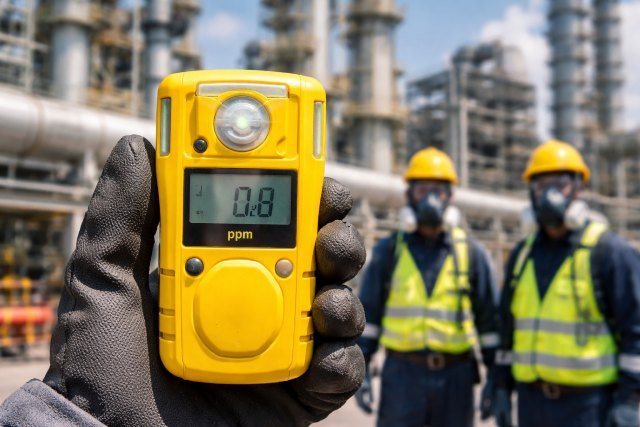

A Hydrogen Sulfide Detector isn’t just another safety gadget — it’s a frontline control for one of the fastest-acting toxic gas hazards in industry. Hydrogen sulfide (H₂S) can be present in oil & gas, wastewater, pulp and paper, mining, manure pits, ship holds, and confined spaces. The challenge is that relying on smell is dangerously misleading: humans can detect H₂S at very low levels, but olfactory fatigue can kick in, meaning you may stop smelling it even while it’s still there.
If your job involves confined space entry, sour crude, sewer systems, or any process where H₂S can accumulate, the right detector selection — and the right maintenance routine — can be the difference between a close call and a catastrophic incident.
Why hydrogen sulfide (H₂S) is uniquely dangerous in industry
Hydrogen sulfide is a colorless gas often described as “rotten egg” smelling at low concentrations, but smell is not a reliable warning method over time. More importantly, H₂S can rapidly overwhelm workers at high levels.
From a safety-program standpoint, it helps to anchor decisions to recognized exposure guidance:
- NIOSH IDLH (Immediately Dangerous to Life or Health): 100 ppm
- NIOSH REL: 10 ppm (10-minute ceiling)
- OSHA PEL: 20 ppm ceiling; 50 ppm peak (10 minutes, under specific conditions)
- ACGIH TLV: 1 ppm TWA; 5 ppm STEL (not a regulation, but commonly used in IH programs)
This is why choosing a Hydrogen Sulfide Detector is about more than “does it alarm?” — it’s about alarm strategy, response time, range, durability, and whether your monitoring method matches the task (personal wear vs. area monitoring vs. fixed detection).
Hydrogen Sulfide Detector types
Personal (wearable) H₂S detectors
These are worn in the breathing zone and are typically the minimum standard for workers who may enter H₂S-risk areas. They’re often single-gas monitors focused only on H₂S, designed for simplicity and low cost of ownership.
Best for: routine work in known H₂S environments, maintenance rounds, wastewater crews, tank farm operators, and contractors who need fast deployment.
Multi-gas monitors (H₂S + O₂ + CO + LEL)
These are the workhorses for confined space entry and many industrial plants because they address the “big four” hazards: oxygen deficiency/enrichment, combustible gas, carbon monoxide, and H₂S.
Best for: confined space entry programs, hot work screening, turnaround/shutdown work, emergency response staging.
Fixed H₂S detection (continuous plant monitoring)
Fixed detectors are mounted near likely leak sources (pumps, valves, separators, sumps), in trenches, near tank vents, or in enclosed process areas. They usually feed alarms to a controller/PLC/DCS and can activate beacons, horns, and ventilation interlocks.
Best for: permanent process risk, compressor stations, refineries, gas plants, wastewater headworks buildings.
Area monitoring (temporary “fence line” or job site monitoring)
Area monitors can be placed around a work zone — useful during shutdowns, during line breaks, or when opening equipment where a release is possible.
Best for: turnarounds, maintenance shutdowns, construction tie-ins, response readiness.
Best Hydrogen Sulfide Detector options for industrial safety
Below are widely used, industrial-grade options across the most common deployment categories. “Best” depends on your environment, required range, maintenance model, and how your safety program runs day-to-day.
Best single-gas personal monitor for simplicity
Honeywell BW Clip Series (H₂S) is designed for maintenance-free operation in the “turn it on and wear it” category, aimed at reducing downtime and upkeep. Honeywell positions it as running continuously without routine calibration/sensor replacement during its service life.
Where it shines:
- Fast onboarding for contractors and rotating crews
- Lower training load (one-button operation)
- Good fit when you need a basic personal H₂S alarm on every person
Watch-outs:
- Maintenance-free models still require a disciplined bump-test policy to confirm alarms and sensor response before use (more on that below).
Best single-gas personal monitor for clear measurement guidance
Dräger Pac 6500 (H₂S) is known for robust single-gas monitoring with a defined H₂S measurement range (Dräger cites H₂S sensor range of 0.4 to 100 ppm for the Pac 6500).
Where it shines:
- Strong option when you want a dedicated H₂S unit with clear status indicators and industrial ergonomics
- Good for plants where single-gas issuance is standard and multi-gas is reserved for confined space
Watch-outs:
- Ensure the range matches your risk profile; some environments may justify higher-range sensors or additional area monitoring.
Best rugged multi-gas monitor for industrial crews
MSA ALTAIR 4XR is a widely deployed 4-gas unit; MSA documentation includes an H₂S range example of 0–200 ppm in performance specifications.
Where it shines:
- General industry and oil & gas adoption (common accessories, docks, service support)
- Strong fit for confined space entry and routine pre-entry screening
Watch-outs:
- Multi-gas detectors require a tighter maintenance program (bump tests, calibrations, sensor life management).
Best multi-gas for flexibility from personal wear to confined-space pump sampling
Industrial Scientific Ventis MX4 is positioned as a rugged, lightweight multi-gas monitor, with an optional slide-on pump for sampling — useful when you need diffusion monitoring most of the time and pumped sampling for specific confined spaces.
Where it shines:
- One platform that can serve multiple workflows (wearable + pumped sampling)
- Helpful for teams that alternate between routine work and confined space entry
Watch-outs:
- Confirm sensor range requirements; H₂S sensor configurations can vary by model and sensor type.
Quick comparison: choosing the right detector class
| Use case | Best detector type | Why it works |
|---|---|---|
| Everyone in an H₂S-risk zone needs basic alarming | Single-gas H₂S wearable | Simple, low training burden, easy compliance |
| Confined space entry program | Multi-gas (H₂S/O₂/CO/LEL) + pump when needed | Covers main atmospheric hazards + sampling capability |
| Permanent process areas with leak potential | Fixed H₂S detection (with controller) | Continuous monitoring + automated alarms/interlocks |
| Shutdowns, line breaks, temporary risk zones | Area monitor(s) + personal monitors | Early warning to crews, better situational awareness |
How to choose a Hydrogen Sulfide Detector for your site
1) Match detection range to real exposure scenarios
A detector’s measurement range should cover:
- expected “nuisance” or low-level chronic presence,
- credible leak scenarios,
- and your emergency response thresholds.
NIOSH lists IDLH at 100 ppm for hydrogen sulfide. In higher-risk environments (e.g., sour gas operations), it’s common to pair personal monitors with fixed/area monitoring to reduce the chance of a sudden high-level release overwhelming individuals.
2) Decide: diffusion-only vs. pumped sampling
Diffusion monitors are great for personal wear, but pumped sampling is often preferred for:
- testing atmospheres before opening a hatch,
- checking the bottom of pits/sumps,
- pre-entry confined space verification.
If your confined space program is mature, a multi-gas with a pump accessory can reduce equipment sprawl.
3) Consider cross-sensitivity and “real-world” gas mixtures
Industrial environments rarely contain just one gas. Some sensors respond to interferents; manufacturers publish cross-sensitivity tables and guidance (example: performance specification tables).
If your process includes sulfur compounds, solvents, or cleaning chemicals, treat sensor selection and calibration gas choice as part of your IH plan — not an afterthought.
4) Plan the ownership model: docked fleet vs. “issue and replace”
If you run a large site, automated test/calibration docks can improve consistency and recordkeeping. If you run smaller crews or many contractors, maintenance-free or simplified personal monitors can improve compliance — provided you still implement function checks.
Calibration, bump testing, and the maintenance routine that prevents “false confidence”
One of the most common failure modes in gas detection programs isn’t the hardware — it’s assuming the monitor is working because it turns on.
OSHA’s guidance emphasizes verifying function and accuracy before each day’s use, and references ISEA recommendations for at least daily operational checks. ISEA’s position statement similarly recommends a bump test (function check) or calibration check before each day’s use, aligned with manufacturer instructions.
A practical routine many industrial sites adopt:
- Bump test daily (or before use): confirm the sensor responds and alarms activate.
- Calibrate on a set interval (often monthly/quarterly, sometimes more frequent in harsh environments), and immediately after failed bump tests or suspected exposure to sensor poisons.
- Document everything for audits and incident reviews.
If you want one policy sentence that’s easy to enforce: “No bump test, no entry.”
Fixed hydrogen sulfide detection: what “good” looks like
A personal monitor protects the wearer; fixed detection protects the whole area — and can trigger controls faster than people can react.
Two common fixed-platform examples used in industry:
- Honeywell Sensepoint XCD is presented as a comprehensive fixed detector for flammable, toxic, or oxygen hazards in potentially explosive atmospheres indoors/outdoors.
- Dräger Polytron 8100 EC is positioned as an explosion-proof transmitter for toxic gases or oxygen using plug-and-play electrochemical sensors and industrial outputs/protocols.
Design tips that improve real outcomes:
- Place detectors where gas can accumulate (low points, enclosed spaces, near leak sources).
- Use alarm beacons/horns that are visible/audible in actual ambient noise.
- Tie alarms to ventilation and process interlocks where appropriate.
- Treat calibration intervals as dynamic: reduce intervals if dust, poisons, or harsh atmospheres can affect sensitivity.
What the “best option” looks like in practice
Wastewater headworks building
Risk pattern: intermittent H₂S spikes around influent, wet wells, or sludge handling.
A strong setup:
- Fixed detectors in the headworks and near wet well access points (continuous monitoring).
- Personal single-gas H₂S monitors for operators doing rounds.
- Multi-gas units reserved for confined-space entries into wet wells.
Why it works: fixed detection catches building accumulation early; personal monitors cover walking exposures; multi-gas supports permit-required entries.
Oil & gas production pad (sour service)
Risk pattern: potential for sudden releases; worker movement across a large area.
A strong setup:
- Personal H₂S monitors on every worker.
- Multi-gas for tasks involving confined spaces or hot work screening.
- Area monitors near work zones during maintenance/shutdown.
Why it works: redundancy and layered detection helps when conditions change quickly.
FAQ: Hydrogen Sulfide Detector questions
What is a hydrogen sulfide detector?
A hydrogen sulfide detector is a gas monitoring device that measures H₂S concentration and alarms when levels reach preset thresholds, helping prevent toxic exposure and supporting confined space and process safety programs.
Can you rely on smell to detect H₂S?
No. People can smell H₂S at very low concentrations, but olfactory fatigue can cause the odor to fade even while the gas is still present, making smell unreliable as a warning method.
What are key exposure reference points for H₂S?
NIOSH lists H₂S as IDLH at 100 ppm, and OSHA lists limits including a 20 ppm ceiling and 50 ppm peak (10 minutes, under specific conditions); NIOSH also lists a 10 ppm 10-minute ceiling REL.
How often should I bump test my portable gas monitor?
OSHA guidance and ISEA recommendations commonly point to verifying operation before each day’s use (or before use), following manufacturer instructions.
Should I buy a single-gas H₂S monitor or a multi-gas monitor?
Single-gas is best when the primary hazard is H₂S and you need broad issuance and simplicity. Multi-gas is best for confined space entry and mixed-atmosphere risk (H₂S + oxygen + combustibles + CO).
Conclusion: choosing the right Hydrogen Sulfide Detector for safer worksites
A Hydrogen Sulfide Detector is most effective when it’s matched to the job, backed by a maintenance routine, and deployed as part of a layered safety system. Start with the basics: personal monitoring for exposed workers, multi-gas capability for confined spaces, and fixed detection where continuous process risk exists. Anchor alarm decisions to recognized exposure guidance (like NIOSH and OSHA references), and don’t let “it powers on” substitute for daily bump testing and documented calibration practices.











Leave a comment