

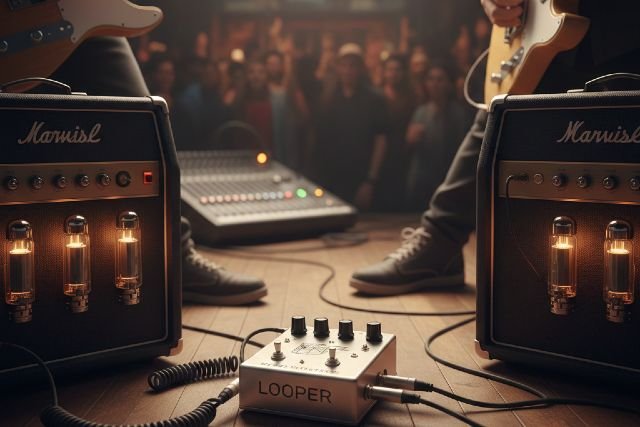

If you’ve ever watched a solo guitarist build a full-sounding “band” in real time, chances are you were hearing a guitar effects looper at work. A looper lets you record a riff or chord progression, play it back instantly, and then layer new parts on top — harmonies, counter-melodies, rhythm stabs, even percussive taps on the guitar body. Done right, it’s the closest thing to cloning yourself on stage: one guitarist, two (or more) guitar roles, and a performance that feels bigger than your hands should allow.
The best part is that you don’t need a stadium rig or a giant pedalboard to start. A simple loop pedal can take you from “practice room noodling” to polished, multi-part arrangements — whether you’re writing songs, tightening timing, or performing solo.
What a Guitar Effects Looper Actually Does
At its simplest, a guitar effects looper records what you play and repeats it in a loop. That repeated audio becomes your backing track. Then you overdub new parts on top, so the loop evolves into a layered arrangement.
Most loopers revolve around the same core actions: you start recording, you stop recording to close the loop and begin playback, and you press again to overdub. Many also include undo/redo, which lets you remove the last overdub if something goes wrong. For example, BOSS highlights that the RC-1 includes the essential looper functions, including record, playback, overdub, and undo/redo.
Once you understand those actions, you stop thinking of the looper as an “effect” and start treating it like a second musician. Your first recorded layer is the rhythm guitarist. Everything you play after that is the lead guitarist, the harmony guitarist, or the texture player — depending on your choices.
How Looping Makes You Sound Like Two Guitarists
The “two guitarists” sound usually comes from separation of roles. In a real band, one guitarist often holds down a consistent rhythmic pattern while the other plays melodies, fills, harmonies, or higher voicings. A looper lets you create that separation by recording the rhythm part first and freeing your hands to play something complementary.
The key word is complementary. If you overdub another part that fights the original rhythm in the same register, the result can blur. If you overdub a part that sits above the foundation — higher voicings, a simple hook, or a tight counterline — the ear naturally hears two distinct guitarists.
A practical mental model is this: your first loop is a “job,” not a showcase. Its job is to carry time and harmony. Your overdub is a second job: carry melody or movement. When you assign jobs like that, the arrangement suddenly sounds intentional.
Guitar Effects Looper Timing: The First Loop Is the Whole Game
If there’s one rule that separates clean looping from chaotic looping, it’s that the first loop has to be solid. Every overdub inherits the timing and length of the original loop. If the loop closes slightly late or slightly early, the entire performance can feel like it’s leaning or stumbling.
Ed Sheeran, one of the most widely known loop-based performers, puts it bluntly in a looping masterclass: if your timing is wrong at the start, it affects the whole thing. That’s not celebrity advice for the sake of it—it’s the physics of looping.
A simple way to improve fast is to treat the footswitch like a drummer’s downbeat. Count a full bar in your head. Start recording exactly on beat one. End recording exactly on beat one when the phrase repeats. When you do that consistently, your loops stop sounding like they were “captured” and start sounding like they were “performed.”
The Best Beginner Habit: Make the First Layer Boring on Purpose
Most players try to impress the looper on the first pass. That’s understandable, but it usually creates two problems. First, busy rhythm parts make it harder to close the loop cleanly because there are too many rhythmic events right near the end. Second, a dense foundation leaves no space for the second guitarist illusion.
A better approach is to record a foundation that is steady and breathable. Two to four chords, a consistent rhythm, and clear chord changes. When you can loop that cleanly, the rest becomes easy. Your lead lines and harmonies will sound more confident because the bed underneath them feels stable.
This also turns your looper into a serious practice tool. Research discussing deliberate practice in music emphasizes that structured practice and repetition are central to skill development and performance gains. A loop can make that repetition feel musical instead of mechanical, which helps you stay engaged long enough to actually improve.
Choosing a Looper Pedal That Helps You Sound Like Two Guitarists
You can sound like two guitarists with almost any looper, but the “feel” of the pedal matters. Your foot control and feedback loop are part of the instrument now. If the pedal is confusing, you’ll hesitate. If it’s clear, you’ll perform.
Some pedals are intentionally minimal. The TC Electronic Ditto Looper, for example, emphasizes essential features like five minutes of looping time, unlimited overdubs, undo/redo, and an analog-dry-through design. That kind of simplicity is great when your main goal is layering parts cleanly.
Other pedals are designed as a straightforward gateway into looping. BOSS describes the RC-1 as a simple, intuitive looper with essential functions and a clear display. If you’re learning timing, visual feedback can help you internalize the loop cycle faster.
The most important buying criterion for the “two guitarists” effect is not how many features you have. It’s how confidently you can start and stop loops without breaking your musical flow.
Where to Place a Guitar Effects Looper in Your Signal Chain
Looper placement affects what gets recorded and how your layers interact. This is where many players accidentally sabotage their own sound.
If the looper is at the end of your pedalboard, it records everything before it. That means your rhythm loop will include your distortion, modulation, delay, and reverb exactly as you set them when you recorded. This can be perfect if you want a consistent rhythm tone and you plan to change your live tone afterward for leads.
If you use amp distortion and your amp has an effects loop, placing the looper in the amp’s effects loop can keep your recorded layers cleaner and more consistent. It can also reduce the “everything gets mushier with every overdub” problem, because you’re not repeatedly stacking gain-heavy audio through the same saturation stage.
If you prefer ambient textures, some players like recording a fairly dry rhythm loop and then adding reverb and delay after the looper so the entire layered arrangement sits in one cohesive space. The tradeoff is that your lead tone will share that same ambient wash unless you manage it carefully.
If you’re building internal content clusters on your site, this is a perfect spot to link readers to a deeper explanation using internal links such as Pedalboard Signal Chain Guide at /blog/guitar-pedal-signal-chain-guide and Reverb vs Delay for Guitar at /blog/reverb-vs-delay-for-guitar.
A Practical Workflow to Sound Like Two Guitarists at Once
Start by deciding what the “other guitarist” would be doing if you were actually playing with a second person. Most of the time, that other guitarist would be keeping time and outlining the harmony while you play melodies and fills. Your looper lets you assign that role to your recorded layer.
Begin with a short chord progression that repeats cleanly. Keep your strumming consistent and your chord changes obvious. When you record, focus less on tone and more on rhythm. Close the loop on a downbeat you can feel in your body, not on a moment you’re guessing at.
Once the foundation is looping, resist the urge to stack another full rhythm part in the same register. Instead, create contrast. Move higher up the neck and play smaller chord shapes. If your foundation uses open chords, your overdub can use triads or partial voicings. If your foundation is bright and chimey, your overdub can be warmer and more mid-focused. The listener’s ear interprets that contrast as two different players.
After that, switch to a lead tone and play a hook that repeats tastefully. Many players ruin their loop performances by soloing nonstop. A better “two guitarists” illusion comes from phrases that answer the rhythm, then leave silence. Silence is what lets the loop feel like a separate musician rather than a backing track you’re fighting.
If your looper supports undo/redo, practice using it without panic. Both BOSS and TC Electronic highlight undo/redo as a key feature on entry-level loopers. In performance, that one function can keep you musical when a layer goes wrong.
How to Avoid the Most Common Looping Mistakes
If your loop has a tiny gap or a weird “bump,” the loop length is probably off. This usually happens when you close the loop at the end of a ringing chord instead of on a clear beat boundary. The fix is to count bars and close on beat one, even if the chord rings over the downbeat. Your ear cares more about timing than about whether the chord stopped perfectly.
If your sound gets muddy as you add layers, you’re likely stacking too many parts in the same frequency range. The easiest fix is register separation. Let the loop own the lower-to-mid range while your overdubs live higher. Another fix is arrangement separation. Let the loop be continuous, but make your overdubs rhythmic or sparse.
If your delays and reverbs turn into a fog, check whether you’re looping time-based effects. When a looper captures delay repeats, each overdub can multiply the ambience. In many rigs, you’ll get cleaner layering by reducing delay feedback before recording the foundation, or by placing your ambience after the looper so it treats the whole arrangement together.
Real-World Uses That Make Looping Feel Like Music, Not a Trick
A guitar effects looper shines in solo performance because it turns one guitarist into an arranger. BOSS’s own beginner guide points out that solo performers have popularized looping by building complete arrangements live. That same idea applies whether you play acoustic in cafés or electric in small venues. Your loop becomes the rhythm guitarist, and your live playing becomes the expressive layer on top.
It also shines in songwriting. When you can instantly loop a chord progression, you can try ten melodic ideas over it without losing the vibe. You can experiment with chord substitutions by re-recording the foundation, then test how the melody reacts. Over time, you’ll start writing parts that naturally “stack,” because you’ve trained your ear to think in layers.
Looping also improves your pocket. Because a loop is unforgiving, it teaches you to lock in. It’s a more musical version of repetition-based practice, which is central to deliberate practice frameworks discussed in music performance research.
Conclusion: Turn Your Looper Into a Second Guitarist
A guitar effects looper works best when you stop treating it like a novelty and start treating it like a bandmate. Record a tight, simple foundation that holds time and harmony, then overdub parts that contrast in register, rhythm, and role. Keep your first loop solid, because it defines everything that follows — a point even looping-heavy performers emphasize when teaching timing fundamentals.
If you build your layers with intention, you won’t just sound like a guitarist with a pedal. You’ll sound like two guitarists making smart arrangement choices in real time. For readers who want to go deeper, you can guide them to related internal pages like Best Guitar Looping Songs to Learn at /blog/best-guitar-looping-songs-to-learn and Live Looping Tips for Beginners at /blog/live-looping-tips-for-beginners.















Leave a comment