

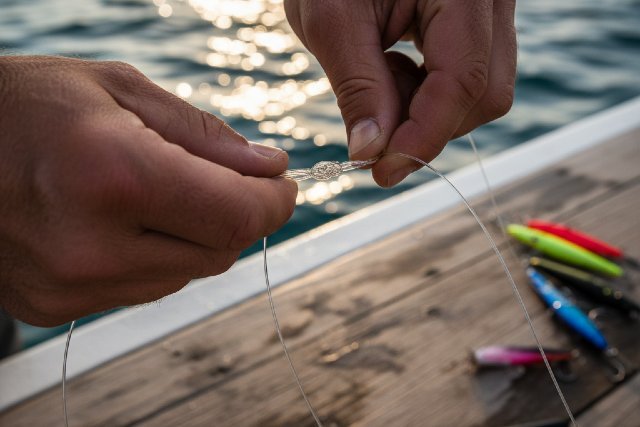

If you fish clear water, pressured lakes, or leader-shy species, a fluorocarbon leader is one of the best upgrades you can make to your setup. Fluoro is nearly invisible underwater, abrasion resistant, and sinks faster than monofilament — but only if you tie the right knots. Choosing the wrong knot for a fluorocarbon leader can cut your line strength by 30–50%, costing you fish and lures.
In this guide, we’ll cover the best fluorocarbon leader knots every angler should know, when to use each one, how to tie them, and common mistakes to avoid. Whether you fish bass, trout, inshore saltwater, or pelagics, these knots will make your rigs stronger and more dependable.
Why Fluorocarbon Leader Matters
Before we dive into knots, it’s worth understanding why the fluorocarbon leader has become a standard in modern fishing.
Key advantages of fluorocarbon leader
- Low visibility: Fluoro has a refractive index closer to water than mono, making it harder for fish to see in clear conditions.
- Abrasion resistance: Great around rocks, docks, shell, and toothy mouths.
- Sensitivity: It’s denser and stretches less than mono, so you feel more bites.
- Sink rate: Fluoro sinks, which helps with bottom contact techniques (jigs, Texas rigs, drop shots).
All that only helps if your knot doesn’t become the weak link. Fluoro is stiffer and harder than mono, so some “favorite” knots lose a lot of strength when used as a fluorocarbon leader connection.
What Makes a Good Fluorocarbon Leader Knot?
Not every knot that works with mono or braid is ideal with fluoro. Great fluorocarbon leader knots share a few traits:
- High actual breaking strength (not just rated)
- Smooth profile to pass through rod guides
- Minimal line burn when cinched
- Good grip on stiff line (fluoro is slick and rigid)
- Repeatable in real-world conditions (cold, wind, on a boat)
For most anglers, you’ll care about two main categories:
- Main line to leader knots – braid to fluorocarbon leader
- Leader to lure/terminal knots – fluorocarbon leader to hook, jig, or swivel
We’ll cover both.
Best Braid to Fluorocarbon Leader Knots
These are your connection knots when running braid main line with a fluorocarbon leader.
1. FG Knot – Strongest Low-Profile Braid to Fluoro Knot
If you want the gold standard connection for braid to fluorocarbon leader, it’s hard to beat the FG knot.
Why anglers love the FG knot
- Extremely strong when tied correctly
- Very slim—flies through guides
- Excellent for heavy leaders and big game fish
- Great for offshore, inshore, and bass fishing
When to use the FG knot
- Heavy cover or big fish (snook, tarpon, tuna, stripers)
- Long fluorocarbon leaders (10–20+ feet)
- When casting distance matters
Basic tying overview (conceptual)
- Lay the fluorocarbon leader under tension.
- Wrap the braid over and under the leader in alternating hitches, usually 16–22 wraps.
- Lock the wraps with a series of half hitches in the braid.
- Trim the fluorocarbon tag close.
- Finish with a few more half hitches and a final Rizzuto finish if desired.
Tip: Always keep the fluorocarbon leader tight while tying the FG knot. Loose wraps will slip, especially with slick braid and stiffer fluorocarbon.
2. Alberto Knot – Great Mix of Strength and Simplicity
The Alberto knot (also known as the Modified Albright) is another favorite fluorocarbon leader knot, especially when you want something easier than the FG.
Pros of the Alberto knot
- Easier to tie than FG, especially on the water
- Works well with braid to fluorocarbon
- More compact than a Double Uni in many cases
- Good for bass, walleye, and inshore species
When to use it
- Medium strength setups (10–30 lb braid to 8–20 lb fluorocarbon leader)
- When you’re new to technical knots
- Bank fishing or kayak fishing where tying an FG is tricky
How to tie (simplified)
- Form a loop in the fluorocarbon leader.
- Pass the braid through the loop and wrap it up the leader 7–10 times.
- Then wrap back down the leader 7–10 times.
- Pass the tag end of the braid back through the loop in the same direction it entered.
- Lubricate and cinch down slowly, tightening from all ends.
3. Double Uni Knot – Beginner-Friendly Braid to Fluorocarbon Leader Knot
The Double Uni Knot (Uni-to-Uni) is a simple and proven way to connect braid to a fluorocarbon leader.
Advantages
- Very easy to learn and remember
- Good all-around strength
- Works with many line types and diameters
- Great for beginners
Downsides
- Bulkier than FG and Alberto knots
- Can catch on rod guides with long leaders
- Doesn’t test as strong as FG in many setups
How to tie (overview)
- Lay braid and fluorocarbon side by side, overlapping several inches.
- On the braid side, tie a uni knot around the fluoro (3–6 wraps).
- On the fluoro side, tie a uni knot around the braid (3–6 wraps).
- Lubricate and pull the main lines to slide the two knots together.
- Trim tags.
Best Fluorocarbon Leader to Lure/Hook Knots
Once your braid is connected to your fluorocarbon leader, you still need a reliable terminal knot.
4. Palomar Knot – Great for Fluorocarbon (If Tied Right)
The Palomar knot is popular because it’s simple and very strong — but some anglers complain it weakens with fluorocarbon. That’s usually due to line burn or overlapping wraps.
When it works best
- 8–20 lb fluorocarbon leader
- Hooks, jigs, and terminal tackle with larger eyes
- Bass fishing (Texas rigs, dropshot, shaky heads)
How to make it fluorocarbon-friendly
- Lubricate heavily before cinching
- Ensure the loop doesn’t cross over itself
- Tighten slowly with steady pressure
5. San Diego Jam Knot (SD Jam) – Excellent Fluoro Knot
The San Diego Jam knot is a favorite for heavier fluorocarbon leaders and big game fishing.
Benefits
- Strong with thick, stiff fluorocarbon (20–80 lb)
- Great for jigs, plugs, and big hooks
- Less prone to slipping than some other knots
Basic tying overview
- Run the line through the eye of the hook.
- Double back alongside the standing line.
- Wrap the tag around both lines 5–7 times.
- Pass the tag through the loop at the eye, then back through the big loop created.
- Lubricate and pull tight, seating the knot at the eye.
6. Improved Clinch Knot – Use With Care on Fluoro
The Improved Clinch Knot is classic — but with fluorocarbon leader, it’s not always ideal, especially at heavier pound tests.
Works best when
- Fluoro is under ~12 lb test
- Used for small hooks or trout lures
- Tied carefully with lots of lubrication
Many anglers switch to Palomar or SD Jam for heavier fluorocarbon because the standard Improved Clinch can slip or weaken the line.
Quick Comparison: Top Fluorocarbon Leader Knots
| Purpose | Recommended Knot | Difficulty | Profile |
|---|---|---|---|
| Braid to Fluoro (max strength) | FG Knot | Hard | Very Slim |
| Braid to Fluoro (easier) | Alberto Knot | Medium | Slim |
| Braid to Fluoro (beginner) | Double Uni (Uni-to-Uni) | Easy | Medium |
| Fluoro to hook (light/medium) | Palomar Knot | Easy | Compact |
| Fluoro to hook (heavy leader) | San Diego Jam | Medium | Compact |
| Fluoro to small hook/light line | Improved Clinch | Easy | Compact |
Tips for Tying Strong Knots With Fluorocarbon Leader
Fluorocarbon behaves differently from mono and braid, so a few habits go a long way:
1. Always Lubricate the Knot
Fluorocarbon can burn if dry when cinched, weakening the line. Use:
- Water
- Saliva
- Fish attractant (if suitable)
2. Tighten Slowly and Evenly
Jerking the knot tight creates friction and heat. Instead:
- Gradually pull all ends
- Seat the knot firmly at the eye or connection point
- Check for smooth, neat wraps
3. Inspect for Damage
After tying, look for:
- Flattened sections
- White, cloudy areas in the fluorocarbon
- Odd kinks or curls near the knot
If in doubt, re-tie. With fluorocarbon leader, a damaged knot will almost always be your failure point.
4. Match Knot to Line Size
Heavier fluorocarbon (20–80 lb) likes:
- FG, Alberto, San Diego Jam
Lighter fluorocarbon (6–15 lb) works with:
- Palomar, Improved Clinch (carefully), Double Uni
Common Mistakes With Fluorocarbon Leader Knots
Avoid these if you want maximum strength from your fluorocarbon leader:
- Using mono habits on fluoro: Some knots that are fine on mono slip or cut into fluorocarbon.
- Under-wrapping connection knots: Too few wraps on FG or Alberto leads to slippage.
- Over-tightening too quickly: Generates heat and weakened sections.
- Ignoring leader diameter: Huge size differences between braid and fluorocarbon make certain knots (like Double Uni) perform worse.
- Not trimming tags properly: Very short tags on fluoro may slip; leave a tiny tag on heavy leaders.
When to Use a Fluorocarbon Leader (and When Not To)
Knowing when a fluorocarbon leader is worth the extra step matters:
Great times to use fluorocarbon leaders
- Clear water: Line-shy species like trout, bass, snook, and bonefish.
- Around abrasion: Rocks, docks, oysters, barnacles, or coral.
- Finesse presentations: Drop shot, Ned rigs, wacky rigs, Neko rigs.
- Inshore saltwater: Redfish, speckled trout, snook, flounder.
When you might skip it
- Very stained or muddy water: Visibility isn’t a big issue.
- Topwater fishing: Some prefer mono leaders that float.
- Short-distance pitching/flipping: Straight fluorocarbon or heavy braid can be fine.
Simple Setup Examples Using Fluorocarbon Leader Knots
1. Bass Finesse Setup
- Main line: 15–20 lb braid
- Leader: 8–10 lb fluorocarbon leader (6–10 ft)
- Connection knot: FG or Alberto
- Terminal knot: Palomar to hook
2. Inshore Saltwater Setup
- Main line: 20–30 lb braid
- Leader: 20–30 lb fluorocarbon (2–3 ft)
- Connection knot: FG knot
- Terminal knot: San Diego Jam to jighead/lure
3. Trout/Light Tackle Setup
- Main line: 6–10 lb braid
- Leader: 4–8 lb fluorocarbon leader
- Connection knot: Double Uni or Alberto
- Terminal knot: Improved Clinch or Palomar
FAQs About Fluorocarbon Leader Knots
1. What is the strongest fluorocarbon leader knot?
For braid to fluorocarbon leader, the FG knot is widely regarded as one of the strongest, especially with heavier lines. For fluoro to hook, Palomar (properly tied) and San Diego Jam are great choices.
2. Is fluorocarbon really that different from mono for knots?
Yes. Fluoro is stiffer and more abrasion-resistant but also more prone to line burn and slipping if the knot isn’t tied and lubricated correctly.
3. How long should my fluorocarbon leader be?
Typical lengths range from 2–8 feet, but some anglers run 10–20+ feet for extreme clear water or stealth presentations.
4. Can I use the same knots for mono and fluorocarbon?
Sometimes — but it’s better to choose knots known to perform well with fluorocarbon, like FG, Alberto, Palomar, and SD Jam, instead of relying on old mono habits.
5. Why does my fluorocarbon knot keep breaking?
Common causes include: tying too fast (heat), not lubricating, using the wrong knot for line size, or mismatched diameter between braid and fluorocarbon leader.
Conclusion
A fluorocarbon leader can dramatically improve your success in clear water and tough conditions — but only if you pair it with the right knots. The FG, Alberto, and Double Uni knots give you strong, reliable braid-to-leader connections, while Palomar and San Diego Jam shine for tying your fluorocarbon leader to hooks and lures.
By slowing down, lubricating knots, and matching the knot to your line size and fishing style, you’ll eliminate weak points and land more fish. Master just a few of these fluorocarbon leader knots, and you’ll be ready for everything from finesse bass tactics to inshore saltwater and even offshore battles.











Leave a comment