

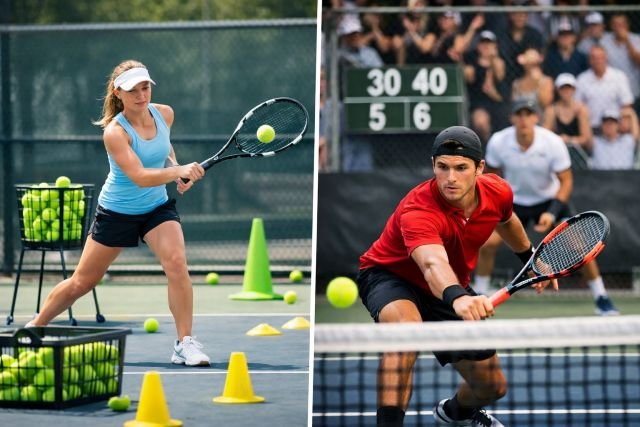

If you’ve ever felt like a different player in matches than you are in practice, you’re not imagining it. In fact, this gap is so common that sports scientists have a name for the core problem: practice that doesn’t “represent” the real performance environment. In this cwtennis guide, we’ll break down why your strokes can look sharp in drills but fall apart when the score matters — and, more importantly, how to build training that actually transfers to match play.
The core issue: practice performance isn’t the same as match skill
Most players train in ways that raise practice performance (you look consistent, feel confident, hit clean) but don’t necessarily raise match skill (you solve points, handle pressure, adapt to chaos). A key reason is that many practice drills are “cooperative,” while matches are “combative” — the opponent is actively trying to disrupt your timing, patterns, and decision-making. Research using tennis tracking data has shown measurable differences between typical practice tasks and match play — suggesting many drills don’t mirror the true demands of competition.
That transfer problem is fixable, but first you need to understand why it happens.
Why you improve in practice but not matches (the 7 biggest reasons)
1) Your drills aren’t “representative” of match play
In matches, every shot includes perception (reading the ball), decision-making (choosing a target/spin/height), execution under time, and recovery for the next ball. Many drills remove at least two of those elements.
When practice becomes predictable — same feed, same pattern, same rhythm — you’re training execution in a stable world, not performance in a chaotic one. Studies comparing practice and match characteristics have found practice often produces longer, more cooperative rallies and different ball/movement features than real match play.
cwtennis takeaway: If your practice doesn’t include real cues, real pressure, and real consequences, your “progress” may be mostly context-dependent.
2) You’re experiencing the “contextual interference” paradox
There’s a well-established learning effect in motor skill research: random, variable practice can look worse during training but improves retention and transfer later. This is known as the contextual interference effect.
So if your practice is mostly blocked (50 forehands cross-court, then 50 backhands), you might feel amazing — yet your brain isn’t being forced to rebuild solutions shot-to-shot like it must in matches.
A 2017 tennis-specific study looked at contextual interference and skill transfer toward match-play contexts, reinforcing why “pretty practice” isn’t always the same as competition readiness.
3) Pressure hijacks attention (and sometimes makes you “overthink”)
Match pressure changes how attention works. Under stress, you may:
- get distracted by consequences (score, ranking, teammates watching), or
- start monitoring mechanics that normally run automatically (“keep your head still, load the leg…”)
This is central to modern “choking under pressure” research, which explains two common failure routes: distraction and explicit monitoring.
What it looks like in tennis:
In practice, your serve is fluid. In matches, you guide it. You “place” instead of “swing.” Or you double fault because you’re thinking about not double faulting.
4) Matches demand better decision-making than most practices train
A lot of practice improves shot quality, but matches reward shot selection.
If you hit 8/10 forehands clean in a closed drill, that doesn’t mean you’ll choose the right height, margin, and target at 30–30 in a windy game when your legs are heavy.
Decision-making is a skill — and like any skill, it needs reps under realistic constraints (score, patterns, opponent tendencies).
5) You don’t train the “between-point” skill set
Matches aren’t just points. They’re routines:
- how you reset after errors
- how you slow down when rushed
- how you manage momentum swings
- how you choose patterns based on score
Most players never practice these deliberately, so they can’t rely on them when it matters.
6) Your physical intensity and fatigue profile changes
Even if your total training volume is high, match play often creates a different fatigue pattern: more adrenaline spikes, more stop-start tension, and different movement demands. Reviews of tennis training vs match-play demands emphasize that understanding competition demands is essential to plan training and recovery appropriately.#
7) Scoring makes you risk-averse (without you noticing)
In practice, you swing freely because the “cost” of missing is low. In matches, missing has consequences, so your brain protects you by choosing safer swings — often at the expense of depth, spin, and intent.
That’s why some players feel like they “tighten up” even when they aren’t consciously nervous.
cwtennis quick table: Practice mode vs Match mode
| Factor | Typical drill practice | Real match play |
|---|---|---|
| Ball pattern | Predictable | Unpredictable |
| Goal | Groove technique | Win the point |
| Feedback | Coach/drill outcome | Score consequence |
| Decision-making | Minimal | Constant |
| Pressure | Low | Variable to high |
| Attention | Skill-focused | Outcome + opponent-focused |
| Learning transfer | Often limited | The real test |
The fix: train for transfer, not just repetition
H2: cwtennis “Match-Transfer Practice” (MTP) framework
Here’s the guiding principle: keep your technique work, but attach it to match-like decisions and consequences as quickly as possible.
Think of training like a slider:
- Technique-first drills (useful early or when rebuilding)
- Representative drills (same skill, but with reads/choices)
- Competitive games (score, consequences, pressure)
- Match simulation (full routines, momentum, tactics)
The common mistake is staying too long at level one because it feels productive.
How to redesign practice so it shows up in matches
1) Keep technique work short — and “bridge” it immediately
Instead of 20 minutes of cooperative rallying, do 6–8 minutes max, then convert it to a decision drill.
Example bridge:
- Phase A (groove): cross-court forehand with a depth target
- Phase B (representative): partner alternates depth; you must decide height and margin
- Phase C (competitive): play cross-court points; winner must hit 2 deep balls before going for angle
This respects how learning transfers: the brain needs to retrieve and adapt, not just repeat.
2) Add variability on purpose (even if it feels worse)
The contextual interference idea predicts that practice may look messier when you add variability, but transfer improves.
Try one “variable block” each session:
- alternate targets every ball
- mix spins (heavy / flatter)
- change heights (net clearance rules)
- add serve location constraints (wide, body, T) randomly
If your practice looks slightly uncomfortable, you’re often closer to match reality.
3) Use “serve + 1” games to connect serving to point-building
Serving practice often becomes isolated: baskets, rhythm, no returner.
A match-transfer alternative:
- You serve to a called zone
- Returner plays live
- You must execute a pre-chosen +1 pattern (e.g., serve wide → forehand to open court)
- Score it (first to 7, win by 2)
This trains execution and the tactical link that wins points.
For contextual interference specifically in tennis serving and transfer contexts, tennis-focused research has examined practice structure and transfer testing.
4) Practice pressure — without turning training into misery
Pressure training works when it’s realistic and repeatable, not chaotic punishment. Since choking can come from distraction or explicit monitoring, the goal is to train attention control and routine stability.
Try “structured pressure”:
- Start every set at 30–30
- Or: “down 0–40, must hold”
- Or: “if you miss 2 first serves in a row, you lose the game”
Then practice your between-point routine exactly the same way each time.
5) Build a simple match routine you can actually follow
A routine is your anti-tilt system.
A solid cwtennis-style routine (keep it short):
- Turn away from the net
- Exhale slowly
- One cue word (e.g., “height” or “legs”)
- Commit to pattern (not outcome)
- Serve/return with the same tempo
You’re not trying to “calm down.” You’re trying to stay organized.
A realistic scenario: why your forehand “dies” in matches
In practice, you rally cross-court and your forehand feels automatic. In matches, the opponent slices low, changes height, and pulls you wide. Now you’re late, you start steering, and you miss.
What happened?
- You trained a forehand in one rhythm and one height
- You didn’t train perception (reading spin/height)
- You didn’t train decisions (safer target vs aggressive)
- You didn’t train under consequence (score)
Fix:
- Add height/spin variability
- Add a decision rule (“If late, go high cross-court with margin”)
- Add scoring so you feel the consequence in practice
Featured-snippet friendly FAQs
Why do I play worse in matches than practice?
Because matches add pressure, unpredictable ball patterns, and constant decision-making. Many practice drills are too cooperative and don’t mirror match demands, so improvement doesn’t transfer well.
What kind of practice transfers best to matches?
Practice that is variable, decision-rich, and scored. Research on contextual interference suggests variable practice can improve retention and transfer even if it looks worse during practice.
How do I stop choking on serve in matches?
Use a consistent between-point routine and practice serving under structured pressure. Choking can be driven by distraction or over-monitoring mechanics, so train attention control and keep cues simple.
How often should I play practice sets?
Ideally weekly (or more) if your goal is match performance — but make at least one session a “match simulation” where you use routines, patterns, and real scoring consequences.
Conclusion: turning practice wins into match wins with cwtennis
If you improve in practice but not in matches, the answer usually isn’t “try harder.” It’s train smarter for transfer. Make practice more representative, add variability that forces real decisions, and rehearse pressure with structure so your routines hold up when the score gets tight. The cwtennis approach is simple: keep technique work, but connect it quickly to match-like cues, consequences, and tactics — so the player you are in practice becomes the player you are when it counts.
If you want, paste your current weekly training schedule (days + what you do), and I’ll rewrite it into a match-transfer plan that still keeps your technical priorities.















Leave a comment