

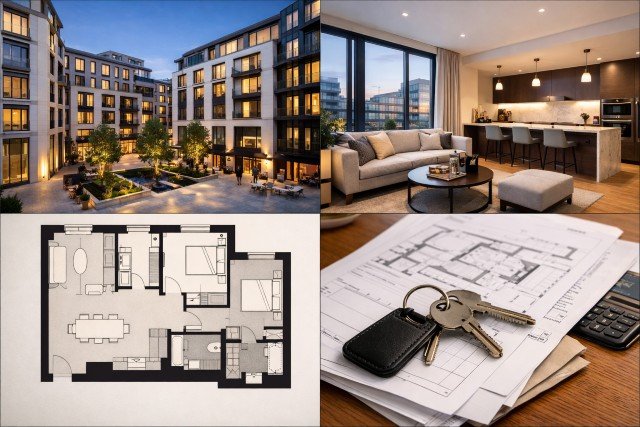

If you’re researching fitzroy place fitzrovia, you’re probably trying to answer a very practical question: is this development “worth it” for the money, and what do you actually get beyond a nice postcode? Fitzroy Place sits in the heart of Fitzrovia, built around Pearson Square and a rare bit of breathing space in W1, with a “private members club” style amenity offer that’s designed to justify premium pricing. It’s also a mixed-use scheme (homes + offices + retail) with strong walkability to Soho, Marylebone, Mayfair and the West End.
Quick definition: what is Fitzroy Place in Fitzrovia?
Fitzroy Place is a mixed-use residential, office, and retail development in Fitzrovia, arranged around a landscaped central square (Pearson Square) and incorporating the Fitzrovia Chapel. The residential element totals 289 homes, and the wider site also includes substantial office space and ground-floor commercial uses.
One reason it’s frequently shortlisted: it combines the “walk-to-everything” reality of W1 with a more private, managed-building feel — concierge, residents’ club facilities, and modern building systems that many period conversions can’t match.
Fitzroy Place Fitzrovia location: what you’re paying for
Fitzrovia is one of those Central London pockets that behaves like several neighbourhoods at once: creative and restaurant-heavy around Charlotte Street, academic and international near UCL/Soas, and quietly ultra-prime as you drift toward Marylebone/Mayfair edges.
For day-to-day convenience, Fitzroy Place positions itself hard on time-savings:
- Tottenham Court Road (including Elizabeth line access) is described as a short walk away by the development itself.
- The scheme is designed around a publicly accessible central square — meaning you get a sense of openness, not just a sealed-off podium garden.
Real-world scenario: If you work in Soho, Mayfair, King’s Cross, the City, or even Canary Wharf, Fitzrovia is one of the few zones where walking or a single, short connection is realistic most days. That lifestyle reduction in friction is exactly what keeps demand resilient in core W1/W1T stock — even when broader London growth slows.
Fitzroy Place Fitzrovia prices: what to expect (and why listings vary)
Let’s be blunt: Fitzroy Place pricing is rarely “cheap for Central.” What you’ll see instead is a wide band based on outlook, floor, building position, terrace/balcony value, and whether parking/storage are included.
Recent sale examples you can use as anchors
A single listing doesn’t define a market, but it helps calibrate expectations:
- 1-bed ~607 sq ft marketed at £1,350,000 (leasehold), with balcony and parking/storage mentioned; service charge and ground rent also disclosed.
- Studio ~419 sq ft with stated service charge £4,709/yr and ground rent £500/yr (helpful for cost modelling even if you don’t buy that unit).
- 2-bed example marketed around £2,995,000 on a portal listing (again, the “why” will be layout + position + spec).
- 2-bed duplex example marketed around £1,899,900, showing that configuration and micro-location can swing pricing significantly.
A simple “price logic” you should apply
In Fitzroy Place, you’re typically paying for a bundle:
- Core W1T walkability (time-value)
- Managed development living (concierge + amenity spaces)
- Modern planning efficiency (less wasted space than many period flats)
- Security + building reputation (stronger on rentals and resales)
But the market will still discount units for things like a compromised aspect, lower floor without outlook, or a layout that “looks big on paper” but doesn’t furnish well.
Fitzroy Place Fitzrovia floor plans: typical layouts, sizes, and liveability
You’ll find studios through penthouses, with a lot of the “sweet spot” demand sitting in efficient 1–2 beds.
A floorplan index site for Fitzroy Place shows multiple configurations (including smaller units around 39 sq m), which lines up with what you see in real listings.
What the most common layouts tend to look like
Studios / compact 1-beds
Often designed for “weekday Central” living: good storage, high-quality finishes, and a strong rental audience. The trade-off is simple — less flexibility if you work from home full-time.
1-bed (roughly ~550–650 sq ft band in many listings)
This is where Fitzroy Place tends to feel most “worth it” if you value location + amenities. One live example: a one-bedroom at 556 sq ft is described as high spec with balcony access and residents’ club facilities.
2-bed / 2-bed duplex
Two-beds can swing wildly based on whether the second bedroom is a true double, whether there’s a terrace, and whether the layout gives you an actual dining zone (not just a widened corridor). Duplexes can feel more “house-like” but check stair placement — badly placed stairs can steal your best wall for sofas/media.
Penthouses / large-format units
These trade on terraces, light, and view corridors. Ultra-prime penthouse marketing materials highlight very large internal areas and extensive terraces (great if you’ll genuinely use outdoor space in London).
Floor plan sanity checks (actionable, not fluffy)
Before you fall for the brochure:
- Measure the “furnishable wall length.” Open-plan is great until you realise you have nowhere to place a proper sofa + dining table without blocking circulation.
- Check bedroom door swings and wardrobe depths. Luxury builds sometimes prioritise sleekness over usable storage.
- Look for a real utility/plant/storage zone. If laundry is in a hallway cupboard, it’s fine — but you want noise and heat managed well.
- Balcony/terrace usability: a narrow balcony can photograph well but function poorly.
What you actually get: amenities, services, and the “members club” effect
A consistent selling point is access to a residents’ club / amenity suite. Across multiple sources, recurring facilities include:
- 24-hour concierge
- Gym
- Private cinema (around ~18–20 seats referenced)
- Treatment / massage room
- Business centre / executive lounge / meeting spaces
- Residents’ lounge / club room
The real value of these amenities (who benefits most)
Amenities are not automatically “value.” They’re value if they replace spending elsewhere.
If you’re in-office 3–5 days/week:
Concierge + security + parcel handling + on-site gym can genuinely simplify your week.
If you travel often:
24/7 staffed buildings reduce stress and can protect downside risk in lettings.
If you work from home full-time:
The business lounge/meeting spaces matter more than the gym. If you’ll never use them, you may be overpaying for lifestyle you don’t consume.
Ongoing costs: service charge, ground rent, council tax, and why they matter
In premium Central developments, monthly ownership cost isn’t just mortgage — it’s building economics.
Examples disclosed on listings include:
- Studio example: service charge £4,709/yr and ground rent £500/yr
- 1-bed example: service charge £7,000/yr and ground rent £1,000/yr
- Larger units can show much higher service charges (one listing shows £29,477.89/yr), which is a reminder that size and building position can scale costs sharply.
How to judge whether the service charge is “worth it”
Ask what it’s buying you:
- staffing levels (concierge hours and coverage)
- maintenance standards (lifts, HVAC, common areas)
- amenity operation (cinema, gym equipment replacement cycles)
- sinking fund health and planned major works
If you’re buying as an investment, service charge sensitivity is real: high fixed costs can compress net yield even when headline rents look strong.
Market context: London pricing and rents (so you don’t buy in a bubble)
It helps to zoom out. Nationally, large lenders reported the average UK home moving above £300,000 in January 2026, showing broader resilience — but Central London behaves differently by micro-market.
For more local context, the ONS local authority housing data for Westminster is a useful reference point for trend direction (even if you still need street-by-street judgement in W1T).
On the rental side, the ONS reports that London rent inflation has been comparatively lower than some regions recently (e.g., London among the lowest annual rent inflation figures in the 12 months to December 2025).
That matters because a premium development with high service charges needs realistic rent growth assumptions.
Who Fitzroy Place Fitzrovia is best for (and who should think twice)
Best fit buyers
- Professionals who want walkable Central without sacrificing building services
- International buyers who prioritise security + concierge and a “lock-up-and-leave” lifestyle
- Buyers who want modern spec over period charm (and don’t want renovation risk)
Think twice if…
- You want the biggest space per pound. Period mansion blocks often win on size.
- You’re highly service-charge-sensitive.
- You need guaranteed quiet: mixed-use schemes can feel lively (which is either a plus or a deal-breaker depending on you).
Buying tips: how to negotiate and what to ask for
If you’re comparing multiple Fitzrovia new-build / luxury developments, treat Fitzroy Place like a product with measurable features.
Practical questions to ask the agent or your solicitor:
FAQ
What is Fitzroy Place Fitzrovia?
Fitzroy Place is a mixed-use development in Fitzrovia built around Pearson Square, combining luxury residential apartments with office and retail space, and known for concierge and residents’ club-style amenities.
How much do apartments cost at Fitzroy Place Fitzrovia?
Prices vary widely by size, layout, and position. Recent examples include a 1-bedroom around £1.35m and 2-bedroom listings ranging from under £2m to around £3m depending on configuration and features like terraces.
What amenities do residents get?
Commonly referenced facilities include 24-hour concierge, a gym, a private cinema, treatment/massage rooms, and business lounge/meeting space — the kind of package often marketed as a private members club experience.
Are service charges high at Fitzroy Place?
They can be. Listings show several-thousand pounds per year for smaller units and materially higher for large, prime units — so you should model total monthly ownership cost, not just purchase price.
Is Fitzroy Place a good investment?
It can be attractive for tenant demand because of location and amenities, but net yield depends heavily on service charges, unit efficiency, and realistic rent growth assumptions in London. For macro rent trend context, ONS data shows London rent inflation has recently been lower than several other regions.
Conclusion: is Fitzroy Place Fitzrovia “worth it”?
For many buyers, fitzroy place fitzrovia earns its premium because it sells a full lifestyle bundle: a rare central square setting, modern high-spec apartments, and a genuine amenity package — concierge, gym, cinema, lounges, and work-friendly spaces — that can meaningfully improve day-to-day living in W1.
The smartest way to judge value is to stop comparing only headline prices. Compare total monthly ownership cost (mortgage + service charge + ground rent), then compare liveability per square foot using floor plans, storage, and furnishing logic. If the building’s services replace real spending and save real time, Fitzroy Place can make sense — even when it looks expensive on paper. If you won’t use the amenities and you’re purely chasing space, you may find better value in Fitzrovia’s best period blocks.
If you want, paste your target budget + preferred unit type (studio/1-bed/2-bed/3-bed), and I’ll map a realistic “what you get” shortlist and the key red flags to watch on floor plans and ongoing costs.
















Leave a comment