

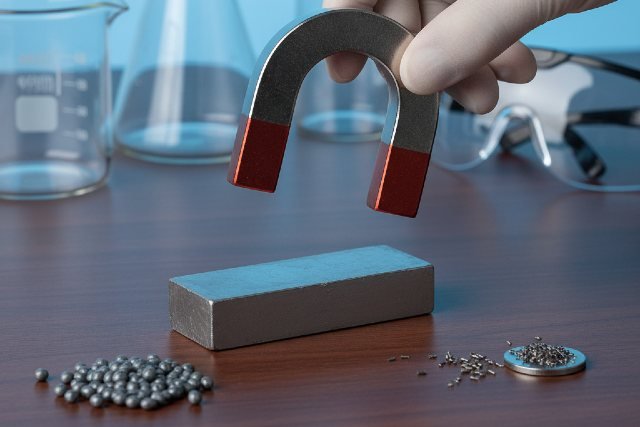

Is Lead Magnetic in Real Life?
If you’ve ever held a magnet up to a fishing sinker, bullet, or old pipe and wondered “is lead magnetic?”, you’re not alone. Lead is dense, heavy, and often associated with metal objects that feel like they “should” respond to magnets. In everyday chemistry, though, lead behaves very differently from metals like iron, nickel, or cobalt.
In this article, we’ll unpack the myth vs reality of lead’s magnetism, explore what science says about lead in magnetic fields, and look at practical examples where this actually matters — like batteries, shielding, and metal identification.
Is Lead Magnetic? The Short, Science-Backed Answer
The Simple Answer
No, lead is not magnetic in the way we usually mean.
A typical fridge magnet, neodymium magnet, or bar magnet will not stick to pure lead.
The Scientific Answer
Lead is diamagnetic. That means:
- It slightly repels magnetic fields
- The effect is extremely weak
- You need sensitive instruments or very strong magnets to notice it
So when people ask “is lead magnetic”, the most accurate everyday answer is:
Lead is non-magnetic for practical purposes, with a very weak diamagnetic response in physics.
Magnetic Categories: Where Does Lead Fit In?
To understand why lead behaves this way, it helps to know the three main magnetic categories for materials:
| Type | Example Metals | Behavior in a Magnetic Field |
|---|---|---|
| Ferromagnetic | Iron, cobalt, nickel | Strongly attracted, can become permanent magnets |
| Paramagnetic | Aluminum, magnesium | Weakly attracted, only while field is present |
| Diamagnetic | Copper, gold, lead | Weakly repelled, effect is very subtle |
Lead clearly belongs in the diamagnetic group, which is why magnets don’t stick to it like they do to iron or steel.
Why Is Lead Diamagnetic?
In simple terms, magnetism at the atomic level is all about electrons—especially their spins and how they pair up.
- Ferromagnetic materials (like iron) have unpaired electrons whose spins can align, creating a strong net magnetic field.
- Diamagnetic materials, including lead, have all their electron spins paired. Those paired electrons create tiny currents that oppose an external magnetic field.
Because lead’s electrons are mostly paired in its electron configuration, it cannot line up spins the way iron does. Instead, it resists the magnetic field slightly, making it diamagnetic.
Everyday Question: Why Do People Think Lead Is Magnetic?
There are a few reasons this myth sticks around:
1. Lead Objects Often Aren’t Pure Lead
Bullets, fishing weights, and pipes may be alloys of lead plus other metals (like antimony, tin, or even steel components). If any ferromagnetic metal is included, a magnet might stick—leading you to think the lead is magnetic.
2. Lead Is Dense and Heavy
People often associate “heavy metal” with magnetism. Lead is very dense (about 11.3 g/cm³), so it feels “magnet-worthy,” even though density has nothing to do with magnetic attraction.
3. Confusion with Other Metals
Lead can be mistaken for steel, zinc, or other grey metals that are magnetic or attached to magnetic parts.
So if you’re wondering “is lead magnetic” because a “lead” object stuck to a magnet, there’s a good chance it wasn’t pure lead.
How to Test If Lead Is Magnetic at Home
You can do a simple test using basic tools:
What You Need
- A strong magnet (neodymium is best)
- The metal sample you think is lead
- (Optional) A scale and water for density testing
Steps
- Magnet Test
- Hold the magnet against the metal.
- If it sticks strongly → the object contains iron/steel (not pure lead).
- If there’s no attraction → likely non-magnetic (possibly lead, aluminum, copper, etc.).
- Visual Check
- Lead is dull grey, soft, and can often be scratched with a knife.
- It’s also denser than aluminum or zinc.
- Density Check (Optional but More Scientific)
- Weigh the object.
- Measure how much water it displaces.
- Compute density = mass ÷ volume.
- Around 11.3 g/cm³ suggests lead.
If the magnet doesn’t stick and the density is high, you’re likely dealing with real lead — and now you’ve answered “is lead magnetic” with your own mini-experiment.
Is Lead Magnetic in Batteries (Like Car or Golf Cart Batteries)?
Lead is famously used in lead–acid batteries, but not because it’s magnetic. Instead, it’s valuable because:
- It’s cheap and abundant
- It participates well in electrochemical reactions
- It’s dense and stable
Inside a lead–acid battery:
- The plates are made from lead and lead dioxide
- The electrolyte is sulfuric acid
- Electricity is stored chemically, not magnetically
So if you’re wondering “is lead magnetic in a battery context?”:
No — lead’s chemistry, not magnetism, is what makes it useful in batteries.
Is Lead Magnetic at Extremely Low Temperatures or in Strong Fields?
In advanced physics experiments, some materials change their magnetic behavior under extreme conditions (like near absolute zero or under enormous magnetic fields).
For lead:
- It becomes a superconductor at very low temperatures (around 7.2 K)
- Superconductors exhibit perfect diamagnetism, also known as the Meissner effect, where they completely expel magnetic fields
This is a special case used in physics research — not something that happens with everyday lead pipes, bullets, or weights in your garage.
So even in exotic conditions, if we’re strict, the answer to “is lead magnetic” is still “no” in the ferromagnetic sense — though its diamagnetic behavior becomes more extreme.
Lead vs Other Metals: Magnetic Comparison Table
Here’s how lead compares with other common metals people wonder about:
| Metal | Magnetic? (Everyday Sense) | Category | Magnet Sticks? |
|---|---|---|---|
| Lead | No | Diamagnetic | No |
| Iron | Yes | Ferromagnetic | Yes |
| Nickel | Yes | Ferromagnetic | Yes |
| Copper | No | Diamagnetic | No |
| Aluminum | No | Paramagnetic | No (very weak attraction) |
| Gold | No | Diamagnetic | No |
| Stainless steel (some grades) | Sometimes | Varies | Sometimes |
This is why your refrigerator magnet loves steel but ignores lead, copper, and aluminum.
Is Lead Magnetic Enough to Use in Magnetic Separation?
Magnetic separation involves using magnets to pull metals out of mixtures—for example, recycling plants separating steel cans from aluminum ones.
Lead is:
- Not attracted to magnets
- Only slightly repelled as a diamagnetic material
So magnetic separation won’t lift lead out of scrap. To separate lead, industries use:
- Density differences (since lead is very dense)
- Chemical processes
- Smelting or refining
So again, in practical terms, “is lead magnetic?” → No, it’s useless for magnetic separation.
Where Lead’s Non-Magnetic Nature Actually Matters
Lead’s lack of magnetism isn’t just trivia — it has real-world uses:
1. Radiation Shielding
Lead is widely used as:
- X-ray shielding in hospitals
- Radiation protection in nuclear facilities
Its non-magnetic nature means it doesn’t interfere with certain sensitive magnetic measuring devices.
2. Cable Sheathing & Electronics
Lead’s non-magnetic and shielding properties made it useful (historically) in cable sheathing, though its use has declined due to toxicity concerns.
3. Balancing Weights (Wheels, Fishing, etc.)
Lead wheel weights and sinkers don’t mess with magnets or magnetic sensors, which can be handy in some mechanical systems.
Common Myths Around “Is Lead Magnetic?”
Let’s bust a few:
Myth 1: “Lead bullets are magnetic, so lead is magnetic.”
Most bullets aren’t pure lead — they may have steel jackets or cores that are magnetic.
Myth 2: “Heavy metals are magnetic by default.”
Magnetism depends on electronic structure, not weight. Gold (heavy) isn’t magnetic; aluminum (light) barely is.
Myth 3: “Lead is used in batteries because it’s magnetic.”
It’s used because of its electrochemical properties, not magnetism.
FAQ: Quick Answers About Lead and Magnetism
Q1: Is lead magnetic at room temperature?
A: No. At room temperature, lead is diamagnetic and does not stick to magnets.
Q2: Is lead slightly magnetic like aluminum?
A: Aluminum is paramagnetic (weakly attracted), while lead is diamagnetic (weakly repelled). In both cases, the effect is too small to notice with a fridge magnet.
Q3: Do magnets stick to bullets?
A: Sometimes — but that’s usually because the bullets contain steel, not because of the lead itself.
Q4: Is lead safe to handle in magnet experiments?
A: Magnetically, yes; chemically, no. Lead is toxic. Avoid dust, fumes, and prolonged skin contact. Wash your hands after handling.
Q5: Is lead magnetic enough to interfere with electronics or MRI machines?
A: No. Lead is non-magnetic and generally safe around magnetic fields — but its toxicity and density are the bigger issues.
Safety Note: Lead Is Non-Magnetic but Toxic
Just because we’re talking a lot about “is lead magnetic” doesn’t mean lead is harmless. It isn’t.
- Lead is toxic, especially to children
- Avoid sanding, grinding, or melting lead without proper protection
- Always wash your hands after handling lead-based objects
- Never use lead items near food or water sources
Magnetism isn’t the concern — health is.
Conclusion: So, Is Lead Magnetic or Not?
Let’s answer the core question clearly:
- Is lead magnetic?
No, not in the way everyday magnets and ferromagnets behave. - Scientifically, lead is diamagnetic, meaning it’s very weakly repelled by magnetic fields — but the effect is so tiny that magnets will not stick to it in normal life.
- In everyday chemistry and physics, you can safely treat lead as a non-magnetic metal, unlike iron or steel.
So the next time someone asks “is lead magnetic?”, you’ll not only know the answer — you’ll understand why, and where that knowledge actually matters in the real world.












Leave a comment