

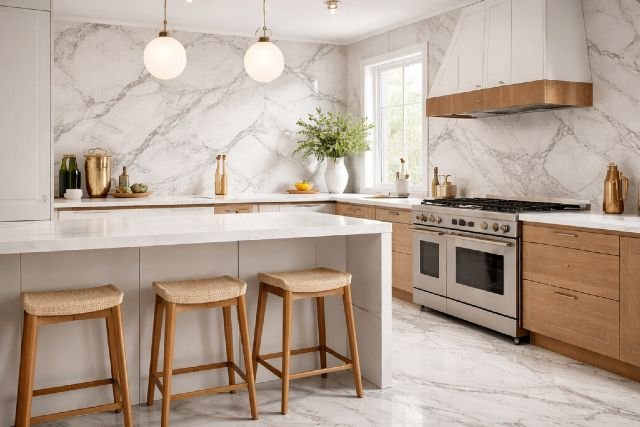

If you want that bright, high-end marble vibe in your kitchen but you don’t want to baby the surfaces, marble effect tiles are the modern solution. They capture the soft veining and polished-luxe look people love in Carrara or Calacatta, yet they’re built for real cooking, real splashes, and real life.
This isn’t just a Pinterest moment either. In the 2025 U.S. Houzz Kitchen Trends Study, tile is the most common choice for upgraded kitchen backsplashes, with 76% selecting tile (versus slab at 24%). The same report shows backsplash coverage trending bigger and bolder: 67% prefer full coverage up to cabinets or the range hood, and 12% take it all the way to the ceiling.
What are marble effect tiles?
Marble effect tiles (often called marble-look tiles or faux marble tiles) are ceramic or porcelain tiles printed and glazed to mimic natural marble patterns. The best versions don’t look flat or repetitive; they include variation from tile to tile, layered veining, and surface finishes that recreate the depth of stone.
Most homeowners lean toward porcelain for kitchens because it tends to be tougher and less absorbent. In ANSI/ASTM definitions, porcelain tile is ceramic tile with water absorption of 0.5% or less (tested under ASTM C373), which is part of why it performs so well in wet, high-traffic areas.
Why marble-look tile often beats real marble in kitchens
Natural marble is timeless, but kitchens are demanding. Cooking oils, tomato sauce, lemon juice, vinegar-based splashes, and even some “natural” cleaners can be a problem for real marble because marble contains calcium carbonate that can react with acids and dull the surface (etching).
Marble effect tiles let you keep the style without the stress. You don’t have to treat your backsplash like a museum piece, and you can get the same “stone statement” look on floors while choosing finishes that fit your household’s safety and maintenance needs.
Marble effect tiles for kitchen backsplashes: ideas that wow
A backsplash is the easiest place to go bold because it’s vertical, it’s highly visible, and it frames your cabinets and countertops like a backdrop. If you want maximum impact with minimal regret, choose your backsplash marble effect tiles first, then harmonize counters, hardware, and lighting around it.
Marble effect tiles as a full-height backsplash
One of the fastest ways to get that “custom kitchen” feeling is full-height coverage. Extending marble effect tiles to the underside of upper cabinets (or wrapping up to the hood) makes the kitchen feel intentional rather than piecemeal. Taking the tile all the way to the ceiling can look especially striking behind a range hood or on a wall with open shelving.
This design move is also increasingly common. The Houzz study reports 67% choosing full coverage up to cabinets or the range hood, and 12% extending to the ceiling.
If you want the look of a marble slab without the slab cost, large-format marble effect tiles help you get there. Fewer grout lines make the surface read more like stone. Under-cabinet lighting then becomes your best friend, because it catches the veining and gives the whole wall depth at night.
Marble look backsplash that “matches” the countertop without being identical
A lot of kitchens look expensive when there’s continuity between the countertop and backsplash. You can mimic that continuity without using the same material by selecting marble effect tiles that echo the countertop’s undertone.
If your counter is a warm white quartz with creamy movement, choose marble effect tiles with warm veining rather than icy gray. If your counter is cool and crisp, a Carrara-style marble effect backsplash will feel calm and clean. The goal isn’t perfect matching; it’s tonal harmony.
Marble look subway tile, upgraded
Subway tile remains a classic because it’s familiar and flexible. Marble effect subway tile elevates it instantly, especially in kitchens where you want “quiet luxury” rather than a loud feature wall.
This option pairs beautifully with transitional kitchens, shaker cabinets, brushed nickel, and soft white paint. It also works well in smaller kitchens where a huge, dramatic vein pattern could feel overwhelming.
Herringbone marble effect tiles for texture without chaos
If you want a backsplash that looks custom but doesn’t fight with the rest of the kitchen, herringbone is a smart move. The layout creates texture and movement, while the marble effect pattern adds depth without requiring a bold color.
Herringbone shines behind a sink wall with a window, or behind open shelves where the tile is partly visible. It also photographs beautifully, which matters if resale appeal is part of your plan.
A dramatic marble effect feature behind the range
A range wall is a natural focal point. It’s where people look when they walk into the kitchen, and it’s the perfect place to spend your “wow budget” visually. A bold Calacatta-style vein or black marble effect tile behind the range can look like a designer feature even if the rest of the backsplash stays simple.
If you do this, keep your grout subtle and choose lighting that flatters the veining. Warm, even lighting makes marble looks feel more natural, while harsh cool lighting can make whites feel sterile and patterns look busier than they are.
Marble effect tiles for kitchen floors: practical ideas that still feel luxe
Floors are where marble effect tiles have to earn their keep. You want elegance, but you also need traction, durability, and a finish that doesn’t make every crumb look like a crisis.
Slip resistance and DCOF, explained in human terms
For level interior spaces expected to be walked on when wet, industry guidance often references a wet DCOF of 0.42 or greater (as stated in ANSI A137.1 guidance and summarized in TCNA materials).
Here’s what that means in practice. If you’re choosing marble effect tiles for kitchen floors, it’s smart to look for tiles with published wet DCOF information and to lean toward matte, satin, or lightly textured finishes, especially near sinks and exterior doors. Also keep in mind that DCOF is only one factor; real-world safety depends on contaminants like oil, how you clean, and footwear choices, which TCNA notes when discussing friction guidance.
Large-format marble look floor tiles for a calmer, bigger feel
Large tiles make a kitchen feel more expansive because the floor reads as one surface rather than a grid. This is especially helpful in open-plan layouts and modern kitchens with flat-panel cabinetry.
Large-format marble effect tiles also reduce grout lines, which can make the floor feel more “slab-like.” If you want that luxury look without the maintenance of natural stone, this approach is one of the most convincing.
Matte Carrara look floors for bright, forgiving kitchens
Carrara-style marble effect tiles are a favorite because they brighten the room and pair well with nearly any cabinet color. In a matte or satin finish, they hide water spots and daily dust better than high-gloss, which is a huge quality-of-life win.
This style is ideal if you want your kitchen to feel airy, especially in spaces with limited natural light.
Warm “greige marble” floors for cozy modern kitchens
If you’re pairing the floor with wood cabinets, brass hardware, or creamy paint, warm-toned marble effect tiles prevent the kitchen from feeling cold. Think soft beige veining, greige backgrounds, and a gentle satin finish that looks refined but not shiny.
This choice also tends to look good across seasons and lighting conditions, which matters if you don’t want to redesign every time you change bulbs.
Dark marble look floors for drama, with a reality check
Black marble effect tile can look stunning and architectural. It’s also honest: it can show dust, flour, and crumbs faster than mid-tone floors. If you love the look, choose a finish that’s not overly glossy and consider a pattern with enough variation to camouflage everyday mess.
The payoff is huge in kitchens with white oak cabinets, white walls, and black accents, where the floor anchors the whole design.
Choosing the right marble effect tile: details that matter
A marble look can succeed or fail based on small decisions. You don’t need to overthink, but you do need to choose intentionally.
Porcelain vs ceramic for kitchen use
For backsplashes, both ceramic and porcelain can work well. For floors, porcelain is often preferred because it’s defined by very low water absorption, which supports performance in damp or spill-prone areas.
If you’re doing both backsplash and floor, you can mix materials. Many homeowners choose ceramic for the wall (more style variety, often lower cost) and porcelain for the floor (more durability-focused).
Finish choice: polished versus honed versus textured
Polished marble effect tiles can look incredibly realistic on a backsplash because the shine mimics polished stone. On floors, polished looks glamorous but can be less forgiving in wet conditions, so honed or satin finishes are often the safer everyday choice for kitchens. The DCOF guidance above is the reason you’ll hear designers talk about finish more than you expect.
Textured finishes can be excellent in family kitchens or in homes where you frequently cook and wash up. They tend to hide scuffs and water marks better, too.
Veining style and scale
Subtle veining is calming and timeless. Bold veining is dramatic and high-impact. The safest rule is to let one surface lead. If you have a busy countertop, keep the backsplash veining quieter. If the countertop is simple, you can choose a backsplash with more drama.
Scale matters as much as boldness. A large, sweeping vein can feel luxurious on a big wall, but on small tiles it can look chopped up. That’s why many designers prefer larger formats for statement veining.
Grout lines and the “real marble illusion”
If you want the surface to read like stone, minimize the visual grid. Larger tile sizes help, and grout color matters even more than most people think. A grout color that blends into the background tone makes the tile feel more seamless and high-end.
Grout color and kitchen maintenance: the choice you’ll feel every day
Grout is where kitchens get real. You can pick the most beautiful marble effect tiles and still end up annoyed if the grout choice doesn’t fit your lifestyle.
Soft gray grout is a reliable partner for most white-and-gray marble looks. Warm gray or greige is better when your tile has creamy undertones. Dark grout can look sharp in modern kitchens, but it outlines every tile, which makes the overall surface read “tile” rather than “stone.”
If your sink wall sees constant splashes, consider a grout tone that’s slightly deeper than the lightest part of the tile. It won’t change the look much, but it can help the kitchen feel cleaner between deep cleans.
Layout ideas that look custom without feeling trendy
Stacked layouts (straight stack) look modern and architectural, especially on larger tiles. Running bond (a classic offset) feels more traditional and forgiving in homes with older character. Herringbone adds texture and looks artisan, particularly in a narrow backsplash run.
If you want a true “wow” moment, look for marble effect tiles designed for bookmatching, where veining mirrors across two tiles. Behind a range, the effect can feel like a dramatic stone slab installation without the same sensitivity to acids that makes natural marble high-maintenance in kitchens.
Mini scenarios: picking the right marble effect tiles for real kitchens
In a busy family kitchen where water ends up everywhere, marble effect tiles work best when you prioritize a floor finish that’s appropriate for wet-foot traffic and a backsplash that wipes clean easily. Choosing a matte or satin porcelain floor with published wet DCOF information is the practical move, then you can add elegance with your backsplash choice.
In a small kitchen that needs to feel bigger, large-format marble effect tiles reduce visual noise. Full-height backsplash coverage is a strong trick here because it makes the wall feel taller and more intentional. This aligns with what homeowners are increasingly choosing, with full-coverage backsplash installs being the most common direction in the Houzz data.
In a “luxury look, low stress” remodel, the reason marble effect tiles win is simple: real marble requires more careful cleaning and is vulnerable to etching from acids. A marble look backsplash delivers the aesthetic while letting you live normally.
FAQs about marble effect tiles in kitchens
Are marble effect tiles good for kitchens?
Yes. Marble effect tiles are popular in kitchens because they deliver a high-end look with materials that are typically easier to live with day to day. Porcelain versions, in particular, are defined by very low water absorption, which supports durability in wet areas.
Do marble effect tiles look fake?
They don’t have to. Realism depends on print variation, tile size, finish, lighting, and grout color. Larger formats with fewer grout lines and a grout tone that blends into the tile’s background usually look the most natural.
Are polished marble look tiles safe for kitchen floors?
Polished tile can be more slippery when wet, so many homeowners prefer matte or satin finishes on floors. Industry guidance often references wet DCOF values for level interior areas expected to be walked on when wet, and TCNA cautions that DCOF should be considered along with real-world conditions.
What grout color looks best with marble effect tiles?
In most kitchens, a soft gray, warm gray, or greige grout that blends into the tile’s base color looks best. High-contrast grout makes the grid stand out and can reduce the “stone slab” illusion.
Should I take marble effect tiles up to the ceiling?
If you want a strong design statement, yes, especially behind a range hood or on a focal wall. It’s also increasingly common: the Houzz report notes ceiling-height backsplashes at 12%, and full coverage to cabinets or hood at 67%.
Conclusion
If you want a kitchen that looks elevated but lives easily, marble effect tiles are one of the best design-to-practicality upgrades you can make. They deliver that unmistakable marble feel across backsplashes and floors, while letting you choose finishes that fit cooking, cleaning, and safety needs. Homeowners are already leaning into tile-heavy backsplash upgrades and bigger coverage, which makes marble effect tiles a natural fit for today’s kitchen look.
The simplest formula is to pick a marble effect tile with the right undertone for your cabinets and counters, keep grout blending rather than contrasting, and choose a floor finish that makes sense for wet zones. When those pieces line up, the result doesn’t just look good in photos. It feels good to live with, every day.















Leave a comment