

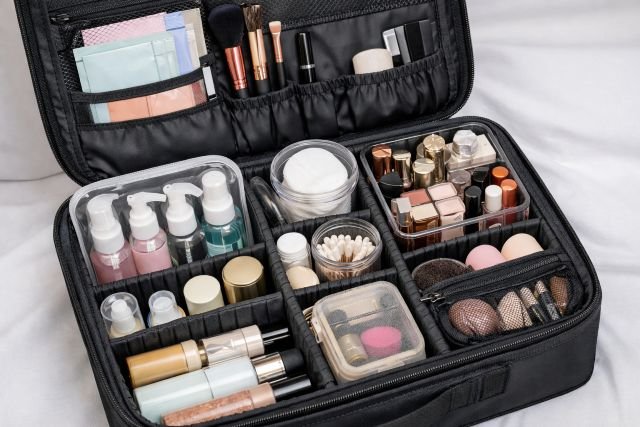

A vanity case is supposed to make your life easier — until the moment you unzip it and find moisturizer on your brushes, foundation smeared across a compact, or shampoo seeping into everything “just in case.” The good news: most spills and space-wasters come from a few fixable habits — how you decant liquids, where you place breakables, and how you “zone” your products so they stay put.
This guide walks you through practical, real-world vanity case organization hacks that prevent leaks, protect powders, and shrink your routine into a clean, grab-and-go setup — whether you’re commuting, traveling, or simply tired of digging for eyeliner at the bottom of your bag.
Why Your Vanity Case Spills and Gets Messy
Most spills aren’t random. They come from the same repeat issues: too much air in half-used bottles, caps that twist as your bag shifts, and products stacked in ways that create pressure points. Even if you never fly, your vanity case goes through a similar process every day—movement, compression, temperature shifts, and friction.
Flying simply makes the problem louder. Commercial aircraft cabins operate at a lower pressure than sea level, and U.S. regulations require pressurized cabins to keep cabin pressure altitude at not more than 8,000 feet under normal conditions. That change can encourage air in partially filled bottles to expand and push product toward seals. The result is the classic “why did my shampoo explode?” moment.
A well-organized vanity case prevents this with two principles: containment and structure. Containment is about stopping leaks from spreading. Structure is about giving every item a stable place so it doesn’t rub, crack, or crush something else.
Vanity Case Organization That Actually Saves Space
The fastest way to save space is to stop treating your vanity case like one big compartment. When products shift freely, you compensate by packing extra “just in case,” and that’s how clutter snowballs. Zoning fixes this.
The Three-Zone Vanity Case Method
Think of your vanity case as three areas that match how you actually use your products.
The first zone is quick-access essentials. These are the items you reach for constantly, so they should live where your hand naturally goes first. When your everyday staples are easy to grab, you stop digging and you stop rearranging everything, which keeps the whole case tidier.
The second zone is liquids and creams. This area should be treated like a contained “wet room” inside your vanity case, because liquids are the most likely to leak and the hardest to clean when they do.
The third zone is fragile and precision items. Powders, palettes, glass bottles, lash tools, and anything with a hinge belong where they’re least likely to get compressed.
This zoning approach works because it reduces friction. When an item has a predictable home, you don’t overpack, you don’t toss things in loose, and you don’t create those tight, chaotic piles that twist caps or crack compacts.
Spill-Proof Vanity Case Packing for Liquids and Creams
If you want spill prevention that feels almost unfairly effective, use double containment. This means every liquid goes inside a sealed pouch before it goes into the vanity case. You’re not just trying to stop leaks. You’re trying to stop a small leak from becoming a full-case disaster.
This also aligns with how airport security expects liquids to be handled. TSA’s 3-1-1 rule requires liquids, gels, and aerosols to be in containers of 3.4 ounces (100 ml) or less, and carried in a single quart-size bag. Even if you’re not going through security, the same approach is perfect for keeping your vanity case clean.
The “Remove Excess Air” Habit That Prevents Leaks
One of the simplest travel-pro tips is to remove excess air from half-used toiletry bottles. The Points Guy specifically recommends squeezing out extra air to reduce the chance of bottles leaking during a flight. The same habit helps in everyday life because less trapped air means less internal pressure pushing product toward the lid as your vanity case gets jostled.
If your bottle is rigid, you can still reduce risk by keeping it more full or switching to a flexible travel container that doesn’t fight pressure as much. The point is to avoid that “half product, half air” situation where air movement becomes the enemy.
Create a Seal on Leak-Prone Bottles
Some caps are simply unreliable, especially snap-tops. If you have a bottle that has betrayed you more than once, treat it like a known risk. A simple way to improve the seal is to add a thin barrier under the cap, then tighten it down so it forms a gasket.
Many travel-hack articles recommend this kind of sealing approach as part of preventing toiletry blowouts and leaks in transit. The reason it works is mechanical: you’re adding a layer that reduces micro-gaps where product seeps out.
Don’t Overfill Travel Bottles
Overfilling makes leaks more likely because product ends up sitting in the cap area and gets pushed into seams with movement. Leaving a little headspace is a practical way to reduce mess, and leak-prevention guides consistently emphasize using sealed bags and smart packing habits to avoid spills.
Space-Saving Product Choices That Keep Your Vanity Case Clean
A vanity case feels “too small” when you pack formats that fight gravity. Liquids and glass bottles take up space, require extra protection, and are the messiest when they fail. You don’t have to replace your whole routine to benefit. Replacing the top one or two spill culprits usually makes a noticeable difference.
Solid formats are the quiet heroes here. Solid perfume, balm cleanser, stick sunscreen, and solid deodorant take up less space and eliminate the “one leak ruins everything” risk. This is especially helpful when your vanity case doubles as a gym bag companion or a daily commuter kit that gets tossed around.
Another space-saving move is decanting by usage, not by container size. When you decant based on how many days you actually need, you naturally shrink the load and stop bringing backup bottles. Your vanity case becomes lighter and easier to reset after each use.
Protect Powders, Palettes, and Tools Without Adding Bulk
Powders break when two things happen at once: impact and pressure. Most vanity case breakage isn’t about dropping the case. It’s about compacts being squeezed between heavier items and then tapped repeatedly as you move.
A clean fix is to create a soft buffer between fragile items and everything else. A thin cloth, a flat pad, or even a soft pouch creates shock absorption without taking up meaningful room. The goal is to prevent direct contact between hard edges and powder lids.
Brushes and tools need protection too, but the trick is to avoid bulky brush rolls that eat your vanity case. A small sleeve or a slim compartment is usually enough if you reduce what you carry to the few brushes you actually use. The vanity case wins when your tools are protected but not overbuilt.
Real-World Vanity Case Setups That Stay Organized
A good vanity case system isn’t the one that looks perfect in a photo. It’s the one that stays functional after you use it.
For a daily commuter routine, keep the vanity case minimal and fast. When the quick-access zone contains only true daily items, you can touch up without unpacking anything else. That’s how you avoid the “exploded bag” effect.
For weekend travel, treat the liquids zone like a dedicated sealed kit. Put every liquid into the same clear pouch, then place that pouch inside your vanity case. If something leaks, cleanup takes seconds, not an hour of wiping makeup off everything.
For events where you want more options, the key is restraint with duplicates. One complexion set, one core palette, and a small touch-up pocket prevents you from rummaging through everything mid-event. A vanity case stays tidy when you can reach what you need without emptying it.
FAQ About Vanity Case Organization
What is a vanity case used for?
A vanity case is used to store and protect beauty, grooming, and toiletry items in a structured way so they’re easy to access and less likely to spill, crack, or get lost.
How do I stop liquids from leaking in my vanity case?
Keep liquids in a sealed pouch inside the vanity case, remove excess air from partially used bottles, and use tighter sealing methods for bottles that frequently leak. The TSA liquids rule also reinforces the idea of keeping liquids together and contained.
Why do bottles leak more on flights?
Cabin pressure is lower than sea level, and regulations require cabins to be pressurized to a cabin pressure altitude not more than 8,000 feet under normal operation. That change can cause trapped air in bottles to expand and push product toward the cap and seams.
How can I fit more in a small vanity case?
Use zoning so items don’t shift, remove duplicates, switch one or two liquids to solid formats, and decant only what you’ll realistically use. A vanity case feels bigger when every item has a purpose and a fixed home.
Conclusion: A Vanity Case That Doesn’t Spill Is a System, Not a Bigger Bag
A vanity case becomes effortless when it’s organized around stability. Zoning keeps your essentials reachable and prevents items from grinding against each other. Double containment stops leaks from spreading. Small protective buffers prevent powder breakage without stealing space. Combine those habits and your vanity case stops being a chaotic catch-all and starts acting like the streamlined tool it was meant to be.
















Leave a comment