

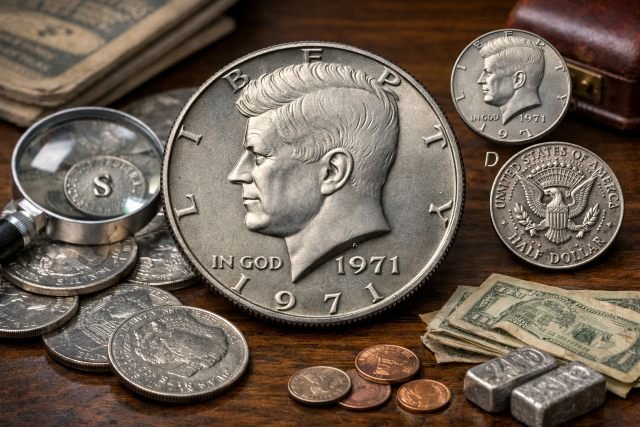

The 1971 half dollar holds a unique place in American numismatic history. As the first Kennedy half dollar issued after the removal of silver from the series, the 1971 half dollar represents a major transition in U.S. coinage. In the first moments of examining this coin, collectors often notice its familiar Kennedy portrait paired with a composition that reflects changing economic realities.
For both beginner and experienced collectors, the 1971 half dollar is more than spare change. Its historical context, mint varieties, and collectible appeal make it an important coin to understand. This guide explains the design, mint marks, errors, and current worth of the 1971 half dollar in clear and practical terms.
What Is the 1971 Half Dollar?
The 1971 half dollar is a Kennedy half dollar struck by the United States Mint for circulation beginning in 1971. It was the first year the coin was produced entirely without silver, using a copper-nickel clad composition.
From 1964 to 1970, Kennedy half dollars contained silver, either 90 percent or 40 percent depending on the year. Rising silver prices made continued silver production impractical, leading to the compositional change seen in the 1971 half dollar.
According to the United States Mint, this shift marked a broader move away from precious metals in circulating U.S. coins.
Historical Context of the 1971 Half Dollar
The Kennedy half dollar was first introduced in 1964 following the assassination of President John F. Kennedy. Public demand was enormous, and the coin quickly became a symbol of national remembrance.
By the late 1960s, however, silver prices rose sharply. The U.S. government gradually reduced silver content, finally eliminating it entirely in 1971. The 1971 half dollar therefore represents the beginning of the modern, base-metal Kennedy series.
This historical shift is a key reason the 1971 half dollar remains a staple in U.S. coin collections today.
Design of the 1971 Half Dollar
Obverse Design Details
The obverse of the 1971 half dollar features a left-facing portrait of President John F. Kennedy. The design was created by Gilroy Roberts, whose initials “GR” appear near Kennedy’s neckline.
The inscriptions include “LIBERTY” along the top edge, “IN GOD WE TRUST” beneath the portrait, and the date “1971” at the bottom. This design remained consistent with earlier Kennedy half dollars.
The sharpness of detail varies depending on strike quality and wear, which plays an important role in collector value.
Reverse Design Details
The reverse of the 1971 half dollar displays the Presidential Seal, designed by Frank Gasparro. A heraldic eagle holds an olive branch and arrows, symbolizing peace and strength.
Above the eagle is a ring of stars representing the states, while inscriptions include “UNITED STATES OF AMERICA” and “HALF DOLLAR.” Gasparro’s initials “FG” appear near the lower right of the design.
This reverse design reinforces the coin’s official and patriotic appearance.
Mint Marks on the 1971 Half Dollar
The 1971 half dollar was produced at three U.S. Mint facilities, each identified by a mint mark.
Coins struck in Philadelphia carry no mint mark. These make up the largest portion of total mintage.
Denver Mint coins display a “D” mint mark located on the obverse near Kennedy’s neck. San Francisco Mint coins carry an “S” mint mark and were primarily produced as proof coins for collectors.
Understanding mint marks is essential when determining the value and rarity of a 1971 half dollar.
Mintage Numbers and Availability
The 1971 half dollar was minted in large quantities, especially at the Philadelphia and Denver mints. Over 300 million coins were produced across all facilities.
Philadelphia alone struck more than 155 million coins, while Denver produced over 234 million. San Francisco struck a much smaller number of proof coins for collector sets.
Because of this high mintage, most circulated 1971 half dollars are common and readily available today.
Composition and Specifications
The 1971 half dollar is composed of a copper-nickel clad structure. The outer layers consist of 75 percent copper and 25 percent nickel, bonded to a pure copper core.
The coin weighs approximately 11.34 grams and has a diameter of 30.6 millimeters. Its reeded edge matches the traditional half dollar format.
This composition distinguishes the 1971 half dollar from earlier silver issues and affects both its intrinsic and collectible value.
How Much Is a 1971 Half Dollar Worth?
The value of a 1971 half dollar depends largely on condition, mint mark, and whether the coin is a proof or error variety.
In circulated condition, most 1971 half dollars are worth face value or slightly more, typically around fifty cents to one dollar. Uncirculated examples can command higher prices, especially those with strong luster and minimal marks.
Proof coins from the San Francisco Mint are more desirable, often selling for several dollars depending on condition and original packaging.
According to pricing guides from PCGS and NGC, top-grade uncirculated and proof examples can reach significantly higher values at auction.
1971 Half Dollar in Uncirculated Condition
Uncirculated 1971 half dollars show no signs of wear and retain original mint luster. These coins are often graded by third-party services using the Sheldon scale.
Coins graded MS65 or higher are especially appealing to collectors. Sharp details, clean surfaces, and strong eye appeal contribute to higher values.
Because many coins entered circulation, truly high-grade examples are scarcer than raw mintage numbers suggest.
1971 Half Dollar Proof Coins
Proof 1971 half dollars were struck at the San Francisco Mint using specially prepared dies and polished planchets. These coins feature mirror-like fields and frosted design elements.
Proof coins were sold in annual proof sets and were not intended for circulation. As a result, they are usually found in excellent condition.
Collectors value proof 1971 half dollars for their visual appeal and historical significance as part of early modern proof sets.
Common Errors and Varieties
Error coins add another layer of interest to the 1971 half dollar series. While not extremely common, certain errors do exist and can be valuable.
Examples include off-center strikes, double strikes, clipped planchets, and weak strikes. Some coins show doubling in lettering or design elements, although true doubled dies are rare.
Verified error coins authenticated by professional grading services often sell for premiums well above standard examples.
Collecting the 1971 Half Dollar
For beginner collectors, the 1971 half dollar is an accessible entry point into U.S. coin collecting. It is affordable, widely available, and historically significant.
Advanced collectors may focus on assembling high-grade sets, proof examples, or certified error coins. Some collectors also pursue complete Kennedy half dollar date and mint mark collections starting with 1971.
The coin’s availability makes it ideal for learning grading, storage, and valuation skills.
How to Store and Preserve a 1971 Half Dollar
Proper storage helps preserve the condition and value of a 1971 half dollar. Coins should be kept in a cool, dry environment away from moisture and contaminants.
Using coin holders, flips, or capsules designed for numismatic storage prevents scratches and oxidation. Proof coins benefit especially from protective cases to preserve their mirrored surfaces.
The American Numismatic Association emphasizes that handling coins by the edges reduces the risk of damage and fingerprints.
Is the 1971 Half Dollar a Good Investment?
While most 1971 half dollars are not rare, select examples can appreciate over time. High-grade uncirculated coins, proofs, and certified errors tend to hold the most potential.
Collectors should view the 1971 half dollar as a long-term collectible rather than a short-term investment. Its value lies in historical importance and condition rather than precious metal content.
Market trends tracked by PCGS show steady demand for quality Kennedy half dollars across multiple decades.
Common Questions About the 1971 Half Dollar
Does the 1971 Half Dollar Contain Silver?
No, the 1971 half dollar contains no silver. It is made from a copper-nickel clad composition.
Why Is the 1971 Half Dollar Important?
It marks the first year of completely silver-free Kennedy half dollars, representing a major shift in U.S. coinage history.
Can I Find a Valuable 1971 Half Dollar in Circulation?
Most circulated examples are worth face value, but uncirculated coins or rare errors can be worth significantly more.
Real-World Collecting Scenario
A new collector inherited a small coin jar containing several Kennedy half dollars. Among them was a bright, uncirculated 1971 half dollar from the Denver Mint.
After professional grading, the coin received a high mint-state grade and sold for significantly more than face value. This scenario highlights how condition, not just age, determines worth.
Stories like this demonstrate why understanding the 1971 half dollar is valuable for both casual and serious collectors.
Trusted Resources for 1971 Half Dollar Research
Collectors can deepen their knowledge using resources from the United States Mint, American Numismatic Association, PCGS, and NGC. These organizations provide reliable data on mintages, grading, and market trends.
Auction records from established numismatic platforms also offer insight into current values and demand.
Using reputable sources ensures accurate identification and fair valuation.
Conclusion: Understanding the 1971 Half Dollar
The 1971 half dollar stands as a defining coin in modern U.S. numismatics. Its transition away from silver, classic Kennedy design, and widespread availability make it both historically important and accessible to collectors.
While most examples are modest in value, high-grade, proof, and error coins offer meaningful collectible potential. By understanding its design, mint marks, and worth, collectors can better appreciate the role the 1971 half dollar plays in American coin history and make informed decisions when buying, selling, or preserving this iconic coin.











Leave a comment